

Life can be overwhelming, but building spiritual habits can help men find balance and purpose. This article outlines seven key practices to strengthen faith and resilience:
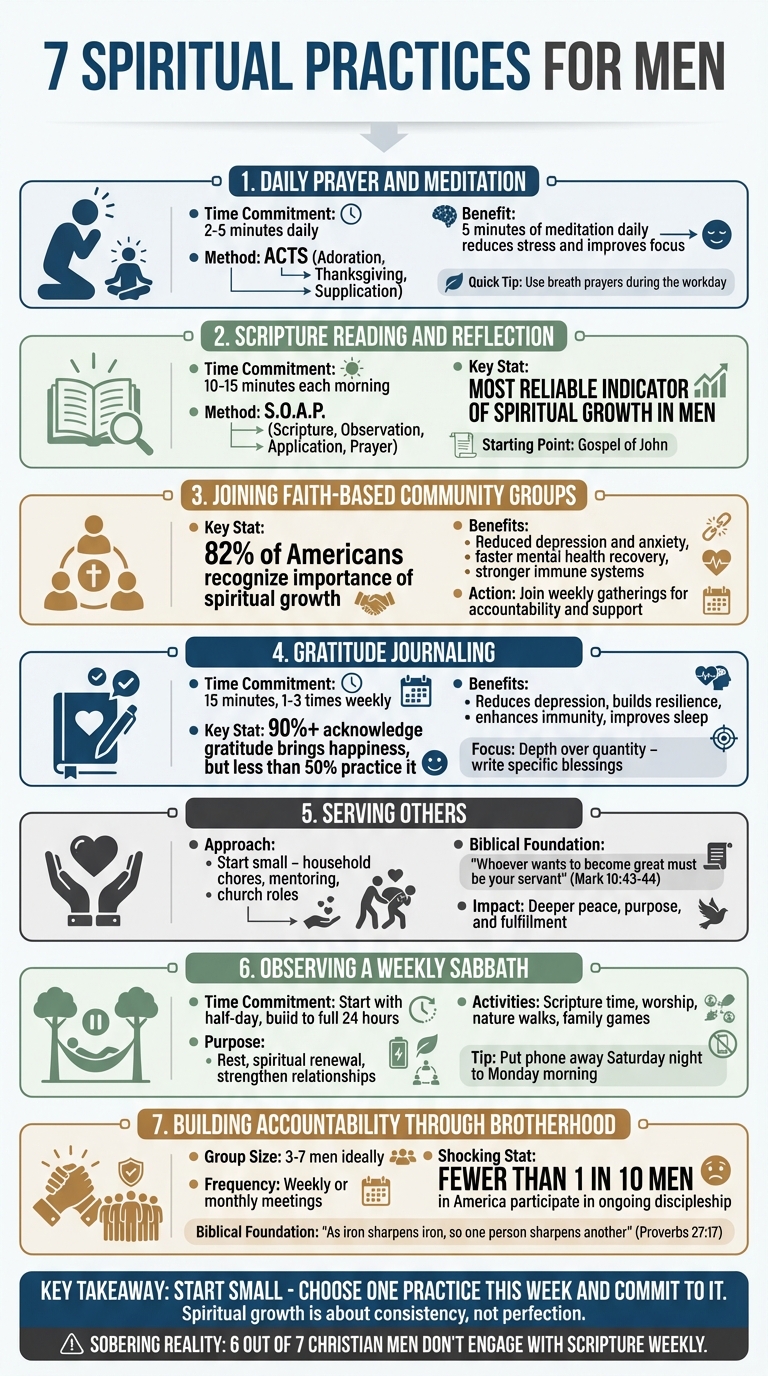
- Daily Prayer and Meditation: Start and end your day with 2–5 minutes of prayer or meditation. Use methods like ACTS (Adoration, Confession, Thanksgiving, Supplication) or breath prayers for focus.
- Scripture Reading and Reflection: Engage with the Bible daily. Start with 10–15 minutes in the morning using tools like the S.O.A.P. method (Scripture, Observation, Application, Prayer).
- Joining Community Groups: Connect with faith-based groups for accountability, support, and shared growth. Look into organizations like Hill Cities for free weekly gatherings.
- Gratitude Journaling: Spend 15 minutes weekly writing specific blessings. Focus on depth over quantity to reshape your perspective on life.
- Serving Others: Commit to small acts of kindness, whether at home, work, or church. Service helps shift focus from self to others.
- Observing a Weekly Sabbath: Dedicate time for rest and spiritual renewal. Start with a half-day if a full Sabbath feels challenging.
- Building Accountability Through Brotherhood: Meet regularly with a small group of men to discuss challenges, share insights, and grow together in faith.
Key takeaway: These habits aren’t about perfection but consistency. Start small – choose one practice this week and commit to it. For support, consider joining a group like Hill Cities to stay on track. Spiritual growth is a journey, and these steps can help you navigate it with strength and clarity.
7 Spiritual Practices for Men: Daily Habits for Faith and Growth
1. Daily Prayer and Meditation
Prayer shifts our attention toward God, moving us away from simply asking for things. Eugene Peterson beautifully explains:
Prayer is first of all a means of listening. Prayer is an act of attention [6].
Setting aside time for prayer acknowledges our human limitations and God’s ability to provide.
To make prayer a part of your daily routine, carve out specific moments for reflection. Start and end your day with brief, focused sessions – just 2–5 minutes can signal your reliance on God [6]. Studies reveal that even 5 minutes of meditation daily can noticeably reduce stress and improve focus [5]. To make it easier, tie this habit to something you already do, like sipping your morning coffee or brushing your teeth.
The ACTS method can help keep your prayers intentional:
- Adoration: Praise God for His character.
- Confession: Acknowledge specific areas where you’ve fallen short.
- Thanksgiving: Express gratitude for His blessings.
- Supplication: Present your needs and the needs of others [6][1].
When you’re unsure what to say, turn to the Psalms. They give voice to every human emotion, from anger to joy [7].
During your workday, try breath prayers – short phrases you can say in one breath, like "Lord Jesus, have mercy on me" or "Help me be your presence." These quick prayers help you refocus on God, whether you’re in a tense meeting, having a tough conversation, or feeling overwhelmed [7].
Keeping a simple prayer log can also be helpful. Jot down requests and note when they’re answered [7][4]. This practice not only sharpens your focus but also strengthens your faith as you see prayers come to fruition.
2. Scripture Reading and Reflection
Reading the Bible isn’t just another task to check off your to-do list – it’s considered the most reliable indicator of spiritual growth in men [1]. Engaging with Scripture regularly feeds your soul in a way nothing else can. As David Burnette puts it:
We need God’s Word more than we need physical sustenance [8].
The Bible serves as the foundation for the Holy Spirit to reshape your mind and transform your heart [8][2]. It’s like a "lamp for the feet", offering guidance when you’re navigating tough decisions at work or leading your family through challenges [1]. In today’s world of constant distractions, daily Scripture reading can act as a mental shield, as Derek Kidner explains:
Whatever really shapes a man’s thinking shapes his life [9].
Much like prayer helps center your focus on God, Scripture keeps your mind anchored in His truth.
If you’re just starting out, aim for 10–15 minutes each morning – a manageable habit that won’t feel overwhelming [1]. A great starting point is the Gospel of John, which provides an approachable introduction to Jesus’ life and teachings [1]. To dig deeper, try the S.O.A.P. method: jot down a Scripture verse, make an Observation about its meaning, identify an Application for your life, and close with a Prayer [1]. This approach is flexible enough to fit even the busiest routines. For example, listening to audio Bibles during a commute or workout can make Scripture accessible on the go [1][2].
Don’t just read – meditate. Tim Keller highlights the power of meditation:
Meditation is thinking a truth out and then thinking a truth in until its ideas become ‘big’ and ‘sweet,’ moving and affecting, and until the reality of God is sensed upon the heart [9].
Find a verse that resonates with you. Reflect on what it reveals about God’s character and how it challenges your thoughts or actions.
Balance is key. Combine broad reading – where you cover larger sections of Scripture – with focused study of specific passages [8]. Memorizing verses like Psalm 23 or the Beatitudes equips you with God’s truth in moments of temptation or stress [2]. The ultimate goal? Let Scripture shape your heart and mind from the inside out.
3. Joining Faith-Based Community Groups
Spiritual growth flourishes when shared with others. Relationships within a community help refine your purpose and strengthen your sense of mission [10].
In fact, 82% of Americans recognize the importance of spiritual growth. Research also highlights that men involved in spiritual communities experience reduced depression and anxiety, faster mental health recovery, and even stronger immune systems [13][12]. Real growth often requires stepping out of your comfort zone and engaging deeply with others – because true transformation happens in the context of active relationships.
As Church On The Move explains:
Maturity doesn’t come from staying in our comfort zones; it comes from engaging in the messy reality of relationships – bearing burdens, forgiving, and working through conflict rather than running from it. [11]
Faith-based groups provide the kind of accountability and encouragement that can help you grow. They also offer a sense of identity rooted in Christ, freeing you from the need to constantly prove yourself [11]. These communities invite you to move from being a passive observer to becoming an active part of something much bigger.
If you’re ready to take that step, consider joining Hill Cities (https://hillcities.org). Founded by Jeff Hagen, Hill Cities hosts weekly gatherings where men can deepen their spiritual lives through thoughtful discussions, supportive resources, and opportunities to make a difference in their communities – all without any cost. Start by attending an informal meeting to see what it’s all about, and commit to showing up regularly to build meaningful relationships and contribute your talents.
4. Keeping a Gratitude Journal
Gratitude journaling, much like prayer and Scripture reading, is a practice that fosters a resilient and faith-focused life. Gratitude is more than just a feeling – it’s a discipline that can transform how you view your daily experiences. Cicero famously said that gratitude "is not only the greatest of virtues, but the parent of all the others" [14]. By writing down your blessings, you train your mind to notice God’s presence in your daily life in both the extraordinary and the mundane, uncovering blessings you might otherwise miss [14][16]. This intentional awareness is the core of keeping a gratitude journal.
Studies show that gratitude journaling can reduce depression, build resilience, enhance immunity, and even improve sleep [14][16]. However, while over 90% of people acknowledge that gratitude brings happiness, fewer than half actively practice it [14]. This gap between understanding and action is where a gratitude journal shines.
To begin, set aside a few minutes weekly for this practice. Start small – 15 minutes, 1 to 3 times a week – to avoid feeling overwhelmed or experiencing "gratitude fatigue" [15][16]. Focus on specific moments, like "I’m thankful my wife made my favorite coffee this morning", instead of creating a long, superficial list [15][16]. The key is depth, not quantity. Writing in detail about one person or event strengthens your gratitude response more effectively than listing multiple items briefly [15].
Another helpful approach is the "subtraction" method – imagine your life without certain blessings to deepen your appreciation for them [15]. Don’t forget to include unexpected surprises, as they often evoke a stronger sense of gratitude [15].
Keep your journal somewhere visible, like your nightstand, to remind yourself to write regularly. Consider journaling at night to calm your mind before sleep or in the morning to set a positive tone for the day [18][19]. Psychologist Nicole L. Francen Schmitt explains, "Gratitude journaling allows people to challenge their negative thoughts and look at a larger picture" [16]. This simple habit can help you reframe tough days and focus on what truly matters [17].
5. Serving Others Through Acts of Kindness
Service has the power to change both the giver and the receiver. Richard Mattingley, author of Share the Struggle, highlights how acts of kindness can nurture humility, compassion, and gratitude [1]. By focusing on the needs of others instead of your own, you reflect the mindset of Christ. Jesus emphasized this in Mark 10:43-44:
Whoever wants to become great among you must be your servant, and whoever wants to be first must be slave of all [1].
While prayer and Scripture nurture your inner life, serving others allows you to live out your faith. It shifts you from passively receiving to actively growing spiritually. Men who take on personal ministry – whether mentoring, leading small groups, or organizing mission projects – often experience a deeper sense of peace, purpose, and fulfillment [5,8]. Even beyond formal ministry roles, everyday acts of kindness can strengthen your faith.
Service doesn’t have to involve grand gestures. Start small and close to home: step up with household chores without being asked, or plan a meaningful activity for your kids [1]. At work, consider mentoring a colleague or starting a discussion group [3]. Within your church, commit to a regular role, such as greeting visitors, teaching children, or helping with maintenance [1]. Alan Pastian, Campus Pastor at River Valley Church, explains:
If you seek first the kingdom of God, all the other things come together for the day and give you strength to finish the day strong [20].
Hospitality is another way to serve – invite others into your home for meals or small group gatherings [1]. Train yourself to notice unmet needs and quietly address them without seeking acknowledgment [1]. When someone in your family shares a struggle, offer a simple prayer or physical comfort, like a hug [20]. These small actions help you view your time and resources as gifts to be managed for God, cultivating a more grateful perspective on life [2].
Spiritual maturity involves becoming, as Desiring God puts it, a "net burden-bearer and wisdom-dispenser" [21]. This means contributing to the spiritual growth of others rather than focusing solely on personal success. This shift not only shapes your character but also leaves a meaningful legacy for future generations [1].
sbb-itb-cb63123
6. Observing a Weekly Sabbath
In a world that never seems to slow down, setting aside a weekly Sabbath can be a powerful way to recharge your spiritual and emotional batteries. A Sabbath isn’t just about taking a break – it’s about intentionally dedicating time to rest, connect with God, and strengthen your relationships. Caleb Mathis, Pastor at Crossroads, calls it a "holy snow day", offering a much-needed pause from the relentless pace of life and the constant pressure to achieve.
The beauty of observing the Sabbath is that it shifts your perspective. Instead of simply recovering from exhaustion, it allows you to begin your week from a place of spiritual renewal. It’s a reminder that your worth isn’t tied to your accomplishments or income but is firmly rooted in your identity as a child of God. This idea mirrors the rest God took in Genesis 2:2–3, showing us that rest is not just a necessity but a sacred practice.
That said, carving out a Sabbath can be challenging. Life’s demands – chores, errands, and endless to-do lists – don’t simply disappear. To make it work, consider reorganizing your week. Move tasks like grocery shopping, paying bills, or cleaning to other days. If a full 24 hours feels overwhelming, start small with a half-day and gradually build from there. Reducing distractions can also help; try putting your phone away from Saturday night until Monday morning to create a more focused, restful environment.
Once you’ve cleared space in your schedule, fill your Sabbath with activities that feed your soul. Spend unhurried time in Scripture, join a worship service, or engage in simple joys like walking in nature, playing games with loved ones, or reading a good book. Establishing a small ritual – like enjoying a favorite cup of coffee or starting a "Thankful Jar" – can help set the tone for your Sabbath. As Kelley, a single empty-nester, puts it, "Sabbath has been a gift that gets me off the performance treadmill that was killing me."
To truly honor the Sabbath, set boundaries. Reserve this time for God by blocking out meetings and avoiding stressful commitments. It’s natural to feel resistance – whether it’s the belief that constant effort is necessary or doubts about whether God will sustain you during rest. Overcoming this mindset often takes trust and the support of a close-knit group or accountability partner. But once embraced, the Sabbath can become a transformative practice that brings peace and balance into your life.
7. Building Accountability Through Brotherhood
Daily prayer, Scripture, and community are essential for spiritual growth, but accountability takes it a step further by strengthening your walk with Christ in practical ways. Proverbs 27:17 reminds us: "As iron sharpens iron, so one person sharpens another." [1] Yet, the reality is troubling – fewer than 1 in 10 men in America participate in ongoing discipleship [23]. This lack of connection often leaves men isolated, struggling to fully embrace the purpose God has for them.
Accountability through brotherhood offers a meaningful way to counteract this isolation. By meeting regularly with a small group of men – ideally 3 to 7 members [22] – you create a space where trust and honesty can thrive. These intimate gatherings encourage authentic conversations, fostering both personal growth and stronger leadership in your family, church, and community [1].
For accountability to be effective, it requires structure and dedication. Set up regular meetings, whether weekly or monthly, in a consistent and distraction-free environment. Agree on key principles like confidentiality, respect, and prioritizing the group. Discussions can be enriched with thoughtful, challenging questions such as: What obstacles are currently hindering your relationship with God? or Have you been intentional about keeping your thoughts and actions pure this week? [24]
If you’re looking for a place to start, Hill Cities offers free weekly gatherings designed to connect men who are committed to spiritual growth. Founded by Jeff Hagen, Hill Cities provides a supportive framework for building genuine relationships rooted in faith. These groups complement your personal spiritual practices, helping you stay accountable while growing alongside others.
Accountability doesn’t bring immediate change – it’s a gradual process that sharpens your character over time. Isolation, on the other hand, keeps you stuck in a cycle of unfulfilled intentions. Choose brotherhood, and watch how it refines your faith journey and strengthens your relationship with God.
Hill Cities as a Resource for Spiritual Growth

Hill Cities takes the concepts of accountability and Christian men’s fellowship and brings them into a vibrant community setting designed to help men grow spiritually.
If you’re looking to move beyond a solitary faith journey and embrace genuine community, Hill Cities provides the tools to do just that. Founded by Jeff Hagen, this organization connects men through free weekly gatherings aimed at deepening their relationship with God while fostering meaningful connections with others.
These Men’s Groups offer more than just a space to meet – they create a shared purpose. Through structured discussions, participants are encouraged to share spiritual insights, assess their prayer habits, and identify actionable steps for personal growth. As Hill Cities explains:
When men connect with God and each other, amazing things happen and the Kingdom can impact the city in ways not possible before.
In addition to these gatherings, Hill Cities provides a robust collection of digital resources. From podcasts and videos to articles, their library addresses topics like fear, anxiety, spiritual doubt, and seasons of dryness. You’ll also find practical tools to develop consistent Bible study and prayer habits. For those new to Christianity, there’s even a checklist covering essentials like community involvement, baptism, and renewing your mindset.
A key element of Hill Cities’ approach is small-group accountability. This reinforces the practices shared in the weekly meetings and helps men confront challenges with Scripture as their guide. Their resources emphasize the importance of facing struggles directly, as highlighted by Hill Cities:
When we face our weaknesses head-on, we invite real spiritual power.
Joining is simple – participate in a weekly Men’s Group to experience this community-driven approach to spiritual growth. Hill Cities’ resources align perfectly with the seven practices discussed in this article, offering a clear path to building spiritual strength and resilience in everyday life.
Conclusion
Spiritual growth isn’t about achieving perfection – it’s about showing up consistently. The seven practices shared here – daily prayer, Scripture reading, community involvement, gratitude, service, Sabbath rest, and accountability – offer a practical way to strengthen your faith and character every day.
Here’s a sobering thought: six out of seven Christian men don’t engage with Scripture weekly, even though daily Bible reading is the strongest indicator of spiritual growth[1]. It’s proof that small, consistent actions can make a big difference. Starting small – like taking two minutes for silence or reading five minutes from the Gospel of John – can help you build habits that last[1][25][26].
David Mathis puts it perfectly: “Our perseverance under God lives in our habits, shaping the very essence of who we are”[1]. The choices you make daily don’t just impact your life – they create a legacy for generations to come.
These practices are meant to work together, creating a spiritual foundation that can withstand life’s challenges. And you don’t have to do this alone. Hill Cities offers free weekly gatherings where men can connect, grow, and support each other. With a community by your side, these habits become easier to sustain and more impactful over time.
So start now. Pick one practice and commit to it this week. Spiritual growth begins with one small step toward what truly matters.
FAQs
What are some practical ways to start adding spiritual practices to my daily life?
Start by setting aside just a few minutes each day for spiritual practices that feel both manageable and meaningful. For instance, you could spend 10 minutes each morning reading a Bible verse or reflecting on scripture. Pair this with a simple prayer routine, like the A.C.T.S. method – adoration, confession, thanksgiving, and supplication – to help establish a steady rhythm.
You might also bring mindfulness into your routine by meditating on scripture or sitting quietly to reflect on God’s presence. To stay motivated and supported, consider joining a group that meets regularly, like weekly gatherings at Hill Cities. Having a community can provide the encouragement and accountability you need as you deepen your faith. The focus should be on starting with intention and staying consistent, knowing that even small, steady steps can lead to meaningful spiritual growth.
What are the advantages of joining a faith-based group like Hill Cities?
Joining a faith-based group like Hill Cities offers men a powerful way to deepen their spiritual lives while building resilience for everyday challenges. These groups provide a welcoming space where men can connect with others who share similar values, creating a network of accountability, encouragement, and shared experiences that help strengthen their faith.
Being part of a group like this encourages men to establish regular spiritual habits, such as prayer, studying the Bible, and serving others – practices that are key to personal growth and character development. Beyond that, it’s a chance to form meaningful relationships, discover a sense of purpose, and receive support during tough times. All of this motivates men to actively live out their faith and make a positive difference in their communities.
How can I stay consistent with spiritual practices in my daily life?
Staying consistent with spiritual practices takes effort and a bit of planning, but it’s absolutely doable. One way to start is by carving out specific times in your day for things like prayer, Bible reading, or quiet reflection. When these practices become part of your routine, they’ll feel more natural – even when life gets hectic.
It’s also worth considering how your spiritual and physical well-being are connected. For instance, combining prayer or meditation with a walk or light exercise can help you feel more balanced and grounded. The key here isn’t about being perfect – it’s about making steady progress. Small, consistent steps can lead to meaningful, lasting change.
Another great way to stay on track is by surrounding yourself with a supportive community. Weekly gatherings, such as those at Hill Cities, can offer encouragement and accountability, making it easier to stick with your spiritual goals.