

When life’s challenges drag on – whether it’s a lingering illness, a strained relationship, or an exhausting job search – prayer often feels harder to sustain. Doubts creep in, exhaustion takes over, and you may wonder if your prayers even matter. But staying connected to God through prayer is crucial, especially during prolonged struggles.
Here’s what you’ll find in this article:
- Why prayer feels difficult during extended hardships, including distractions, doubts, and fatigue.
- How Jesus’ example of persistent prayer can guide you.
- Practical ways to maintain your prayer life, like relying on Scripture, praying with others, and asking God for endurance.
- The power of community prayer to strengthen faith and provide support.
The goal isn’t quick fixes but tools to help you pray consistently, grow spiritually, and deepen your relationship with God – even when the answers seem delayed.
Why Prayer Becomes Difficult During Extended Trials
Distractions and Doubts
When trials stretch on for months or even years, they can wear down the spirit in ways that a sudden crisis often doesn’t. You find yourself asking, "How much longer can this go on?" That question alone can sap faith and chill the warmth of love [7]. The slow, grinding nature of prolonged suffering doesn’t just test your patience – it can erode your resolve.
This extended struggle often gives rise to what some describe as a "tribunal of vicious accusers" in your mind [1]. These internal voices sow seeds of doubt, questioning your faith and your standing before God. On top of that, spiritual warfare amplifies these doubts, as the enemy works to convince you that your prayers are "powerless, useless, and ineffective", hoping you’ll abandon them altogether [2].
Another challenge is the temptation to rely on your own strength instead of turning to God. Over time, you might feel prayer isn’t working and choose self-reliance instead [8][5]. But this shift can make you forget your complete dependence on Him. Even Solomon, with all his wisdom, faltered under life’s pressures when he strayed from God’s Word [4].
And as if doubts weren’t enough, physical exhaustion often compounds the difficulty of staying committed to prayer.
Physical and Spiritual Exhaustion
Extended trials don’t just test your spirit – they can drain your body as well. Psalm 102 paints a vivid picture of this kind of weariness, describing a life fading away, with the heart and body reduced to "skin and bones" [5]. When you’re physically depleted, even the mental effort required for prayer can feel overwhelming. Sometimes, you might be too tired to keep asking.
This exhaustion can lead to a dangerous cycle. You might start projecting your own fatigue onto God [3], assuming He’s grown weary of hearing your prayers, just as you’ve grown weary of offering them. But Tim Challies offers a comforting reminder:
The elapsing of time may cause you to grow weary or lose heart, but it has no bearing on him and on his ability or willingness to answer your prayers [3].
God exists outside of time, which means a prayer you whispered a decade ago is as fresh to Him as one you said this morning.
However, fatigue can also create an opening for what some call the "lazy flesh" to take over [2][9]. You might convince yourself that you’re simply submitting to God’s will, but in reality, exhaustion is what’s stopping you. Lexicographers W. Arndt and F.W. Danker explain that the Greek term for "lose heart" literally means "to lose one’s motivation in continuing a desirable pattern of conduct or activity, lose enthusiasm, be discouraged" [2]. This is exactly what happens when prolonged trials leave you drained and without visible signs of change.
sbb-itb-cb63123
How to Maintain Prayer During Long Trials
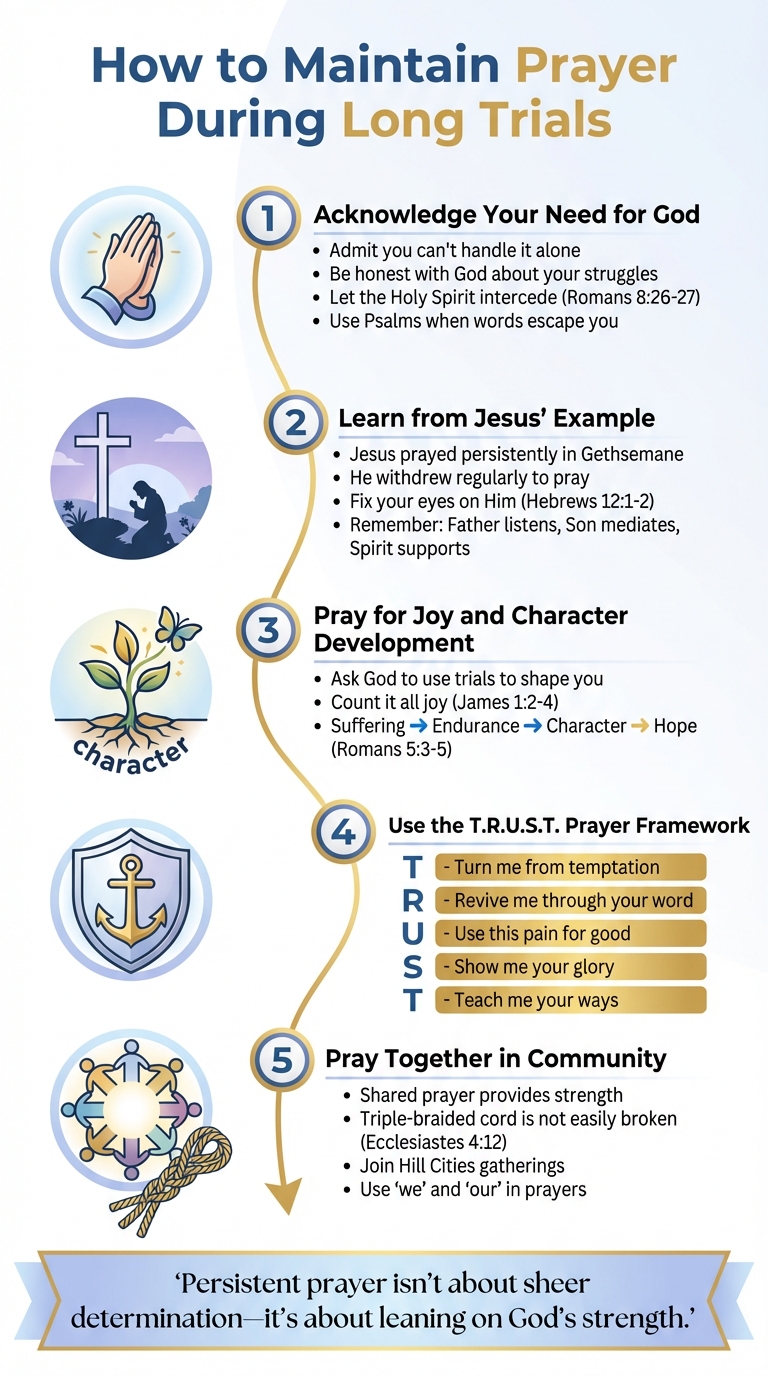
How to Maintain Prayer During Long Trials: 5 Practical Steps
Acknowledge Your Need for God
Keeping up with prayer during prolonged suffering starts with admitting you can’t handle it all on your own. Prayer isn’t just another task – it’s a lifeline, a way to tap into divine strength when you’re at your weakest. Even when you’re too drained to find the words, the Holy Spirit steps in, interceding with "groanings too deep for words" (Romans 8:26–27).
Be honest with God about where you are. If your heart feels distant or you lack the desire to pray, tell Him. Ask for the desire to be restored. Scripture offers encouragement: Hebrews 10:36 reminds us of the need for endurance, while James 1:2–5 calls us to seek wisdom during trials.
When words escape you, turn to the Psalms or well-known prayers like the Serenity Prayer to help refocus your heart. This isn’t about weakness – it’s about acknowledging the grace that keeps you going. Follow Jesus’ example of leaning on God in complete dependence, even in the toughest moments.
Learn from Jesus’ Example
Jesus showed us what persistent prayer looks like, even in the most challenging circumstances. In the Garden of Gethsemane, he prayed repeatedly – not because God wasn’t listening, but because his heart needed to fully surrender. Jesus often withdrew to pray, showing us the importance of staying connected to the Father. Hebrews 12:1–2 encourages us to fix our eyes on him, reminding us that life is a race where we must shed anything that holds us back.
When you’re feeling overwhelmed, think about Jesus’ prayers in Gethsemane. His persistence and trust are examples of how to approach trials. He isn’t a distant figure watching from afar – he’s a compassionate High Priest who intercedes for you. In your weakest moments, the Father listens, the Son mediates, and the Spirit supports you. You’re never praying alone.
Pray for Joy and Character Development
Instead of focusing only on escaping your struggles, ask God to use them to shape you. James 1:2–4 challenges us to "count it all joy" when facing trials, knowing they build perseverance and character. Romans 5:3–5 explains how this works: suffering leads to endurance, endurance shapes character, and character brings hope – a hope that never disappoints.
Pray intentionally for patience and the ability to see God’s glory, even in the waiting. A helpful guide is the T.R.U.S.T. acronym:
- Turn me from temptation
- Revive me through your word
- Use this pain for good
- Show me your glory
- Teach me your ways
Incorporate these prayers into your daily life. Set a reminder to pause midday or wear a bracelet to prompt you to "pray without ceasing" (1 Thessalonians 5:17). The goal is to make prayer a natural rhythm in your day-to-day life.
Praying Together in Community
The Strength of Group Prayer
When facing prolonged trials, communal prayer offers something individual prayer often cannot – a shared source of strength and hope. In moments when your faith feels fragile, having someone else pray for you can restore what feels lost. Dietrich Bonhoeffer captured this beautifully:
The Christ in his own heart is weaker than the Christ in the word of his brother; his own heart is uncertain, his brother’s is sure[10].
This is the beauty of praying together – it ensures you’re never left to face challenges on your own.
Group prayer acts as a powerful defense against feelings of doubt and despair. Think of Ecclesiastes 4:12, which describes how a triple-braided cord is not easily broken[2]. When you gather to pray with others, you reinforce each other’s faith and resilience during hard times[10].
Praying in a group also brings fresh insights into God’s character. Tim Keller explains how hearing others pray can reveal new perspectives on Jesus that you might not have noticed alone:
By praying with friends, you will be able to hear and see facets of Jesus that you have not yet perceived. . . . Knowing the Lord is communal and cumulative, we must pray and praise together[10][12].
Even when gratitude feels out of reach for one person, another’s thankfulness can inspire the whole group. This shared experience of prayer builds a collective sense of hope and encouragement, especially in seasons of struggle[12].
Using These Practices at Hill Cities Gatherings

While personal prayer helps build spiritual endurance, praying with others adds depth and sustains that strength over time. Hill Cities weekly gatherings provide the perfect environment to live out these principles. Here, prayer takes center stage – going beyond simply sharing requests[11][13].
Start with Scripture-based prayers, using phrases like "we" and "our" to emphasize shared burdens and unity[13]. To keep things fresh, vary the focus each week: one meeting could center on thanksgiving, another on confession, or perhaps prayers for specific members facing trials[11]. Incorporating physical gestures, such as kneeling or laying hands on someone, adds a tangible expression of shared support[13].
These practices turn gatherings into more than discussions – they become moments of spiritual battle, pushing back against the discouragement that can threaten perseverance.
Conclusion
Main Points to Remember
Persistent prayer isn’t about sheer determination – it’s about leaning on God’s strength. God operates beyond the limits of time[3]. Unlike the unjust judge in Jesus’s parable, God is a loving Father who is eager to bless His children[15].
Jesus’s example teaches us to seek solitude, endure through hard seasons of prayer, and ultimately submit to God’s will[6]. When answers feel delayed, it might mean spiritual battles are unfolding, faith is being strengthened, or God’s perfect timing is at work[14]. George Mueller’s unwavering decades of prayer remind us that waiting often shapes and deepens our faith[14].
Community can be a lifeline. Hill Cities gatherings show how shared prayer transforms individual struggles into collective resilience. When your faith feels shaky, joining others in prayer can provide the encouragement and strength you need, like a triple-braided cord that won’t easily break[2]. Ask for the Holy Spirit’s renewal to sustain you and stand firm against discouragement.
These principles offer a foundation for renewed hope as you continue your prayer journey.
Final Words of Encouragement
Tim Challies offers this powerful reminder:
You will eventually run out of time to pray, but God will never run out of time to answer[3].
Persistent prayer can have an impact that stretches far beyond our lifetimes, as seen in D.L. Moody’s final prayer list[14]. Every moment you spend in prayer holds meaning.
God’s faithfulness shines through trials, and persistent prayer is about more than just receiving answers – it’s about growing spiritually and building a deeper connection with Him. As you continue praying, you’re being refined, your character is growing, and you’re learning to depend on Christ rather than your own strength[16]. Keep praying, keep gathering with others, and let perseverance deepen your relationship with Christ.
FAQs
How do I pray when I feel numb or exhausted?
When life leaves you feeling drained or numb, take a moment to bring your raw, unfiltered emotions to God. Whether it’s through tears, quiet reflection, or simple cries for help, know that He is listening. Even when you can’t find the right words, trust that the Spirit steps in and speaks on your behalf. God hears every broken or silent prayer and fully understands what you’re going through. Turn to Scripture for strength and reassurance, and trust in His constant presence to carry you through, even when prayer feels like a struggle.
What if God seems silent for a long time?
When it feels like God is silent, it’s easy to feel discouraged or even forgotten. But silence doesn’t mean He’s absent. The Bible often reminds us that seasons of waiting can refine our faith and build deeper trust in Him. During these times, hold on to prayer, lean into His promises, and trust that His timing is always perfect. What may seem like silence could be His way of shaping your character and drawing you closer to His presence.
How can a Hill Cities gathering help me persevere in prayer?
Hill Cities gatherings offer a welcoming space for believers to connect, share their challenges, and uplift one another through prayer and encouragement. These meetings focus on nurturing spiritual growth, building resilience, and deepening trust in God’s timing. Through heartfelt fellowship, meaningful discussions, and lessons drawn from Scripture, participants are inspired to remain steadfast in prayer, even during extended periods of difficulty, strengthening their faith and perseverance along the way.