


When you’re unsure if you’re hearing God’s voice, seeking wise counsel can bring clarity and peace. The Bible emphasizes the importance of involving trusted advisors to confirm decisions. Proverbs 15:22 reminds us, "Plans fail for lack of counsel, but with many advisers they succeed." Here’s how to approach this process:
- Why Counsel Matters: It helps you avoid self-deception, refine decisions, and align with God’s will.
- Who to Seek Advice From: Choose spiritually mature, Scripture-grounded individuals with integrity and experience.
- Steps to Follow:
- Present Your Situation Clearly: Share your thoughts, goals, and concerns humbly.
- Test Advice Against Scripture: Ensure it aligns with biblical principles and brings peace.
- Pray, Wait, and Act: Give yourself time to pray and confirm alignment before moving forward.
Regularly seeking counsel fosters humility, accountability, and spiritual growth. Surround yourself with a small group of trusted advisors, and remember that God’s Word is the ultimate guide.
The Biblical Basis for Seeking Wise Counsel
Scripture makes it clear: seeking wise counsel is essential. Proverbs 11:14 puts it bluntly: "Where there is no counsel, the people fall; but in the multitude of counselors there is safety." This verse highlights how guidance and stability go hand in hand. Without advice, we risk failure, but involving a group of trusted voices in our decisions creates a foundation of security. This principle sets the tone for understanding how wise counsel sharpens our ability to discern.
Proverbs 15:22 builds on this idea: "Without counsel plans fail, but with many advisers they succeed." When we rely solely on our own judgment, our plans are vulnerable to our blind spots and biases. Success often hinges on the insights of others who can see what we miss. Both verses emphasize the importance of multiple perspectives. No one has complete understanding, and inviting diverse viewpoints helps fill in the gaps.
Seeking counsel also helps us refine our understanding of God’s voice. When a plan holds up under the scrutiny of biblically grounded advisors, it’s far more likely to align with God’s will. Think of this as a refining process. The agreement of godly counselors can confirm the Holy Spirit’s guidance, giving us confidence to take action. As Kevin Hay, author of For the Gospel, explains: "The Word of God is the standard by which all advice is weighed." If counsel aligns with Scripture, we can trust it. If it doesn’t, no matter how convincing it sounds, we must set it aside. This testing process ensures we’re not simply following human reasoning but are instead confirming what God has revealed through His Word and Spirit.
Why God Uses Counsel for Confirmation
Beyond the biblical commands, God uses counsel to cultivate humility, accountability, and wise decision-making. While He could speak to us directly, He often works through the community of believers. Why? Because seeking advice requires us to acknowledge our limitations and depend on others. As Proverbs 12:15 reminds us: "The way of a fool is right in his own eyes, but a wise man listens to advice." Relying only on our own judgment is risky – it leaves us vulnerable to self-deception and pride.
The Bible gives us examples of how counsel can lead to either success or failure. Around 1446 BC, Moses heeded the advice of his father-in-law Jethro to delegate leadership roles. This decision preserved Moses’ energy and brought stability to Israel’s judicial system. On the other hand, in 930 BC, King Rehoboam ignored the experienced counsel of his father’s elders and instead followed poor advice, leading to the rebellion of ten tribes and the division of Israel’s kingdom.
Counsel also serves as a safeguard against personal bias. These biblical principles lay the groundwork for the next steps: how to select wise counselors and evaluate their guidance, which we’ll discuss in the upcoming sections.
sbb-itb-cb63123
How to Choose Wise Counselors
When seeking advice, it’s crucial to turn to those with genuine spiritual maturity. Their ability to confirm God’s voice in your life depends on their deep understanding of Scripture and their personal walk with Christ.
Qualities of a Wise Counselor
Character always trumps charisma. As Kevin Hay, author of For the Gospel, wisely states:
A godly man or woman who has walked faithfully with Christ for decades – even if they’re not flashy, popular, or ‘influential’ – will shepherd your soul better than the most dynamic personality who lacks character. [1]
Look for counselors who ground their advice in Scripture. Their lives should show the fruit of the Spirit (Galatians 5:22-23), making them examples worth following [2].
Spiritual maturity often shines through in how someone has handled life’s challenges. According to John B. MacDonald, trials shape individuals into Christlike guides [2]. Seek out those who have weathered difficulties – whether in marriage, parenting, or career – and have remained steadfast in their faith. These experiences often equip them to offer wisdom rooted in both Scripture and personal growth.
A trustworthy counselor will also exhibit selfless love and integrity. They won’t offer advice for personal gain or approval but will genuinely care about your well-being. They’ll ask thoughtful questions to uncover deeper issues rather than giving shallow, quick-fix answers. Most importantly, they’ll speak truth in love, even if it’s uncomfortable, prioritizing your spiritual growth over your immediate satisfaction.
Before entrusting someone with your concerns, ask questions like, "How does your faith influence your approach to counseling?" or "What books or teachings have shaped your perspective?" Confirm that they are active in a local church and that their pastor views them as a wise and faithful advisor. Additionally, ensure they value confidentiality and won’t use your conversations for public attention.
By keeping these qualities in mind, you can identify counselors who will offer guidance rooted in faith and wisdom.
Where to Find Trusted Counselors
Begin your search in your local church. Pastors, elders, and mature believers often serve as reliable spiritual guides.
Small groups and discipleship settings are excellent places to observe someone’s character and faith in action. Watch how individuals interact with others, handle responsibilities, and demonstrate love and service. Don’t wait for a mentor to approach you – take the initiative. Ask an older believer to meet for coffee and discuss the possibility of discipleship.
For men specifically, Hill Cities (https://hillcities.org) provides weekly gatherings designed to foster mentorship and peer connections. These faith-based communities focus on addressing the unique challenges men face in their careers, families, and spiritual journeys. They can be a great resource for finding mentors who understand your struggles and provide biblically grounded advice.
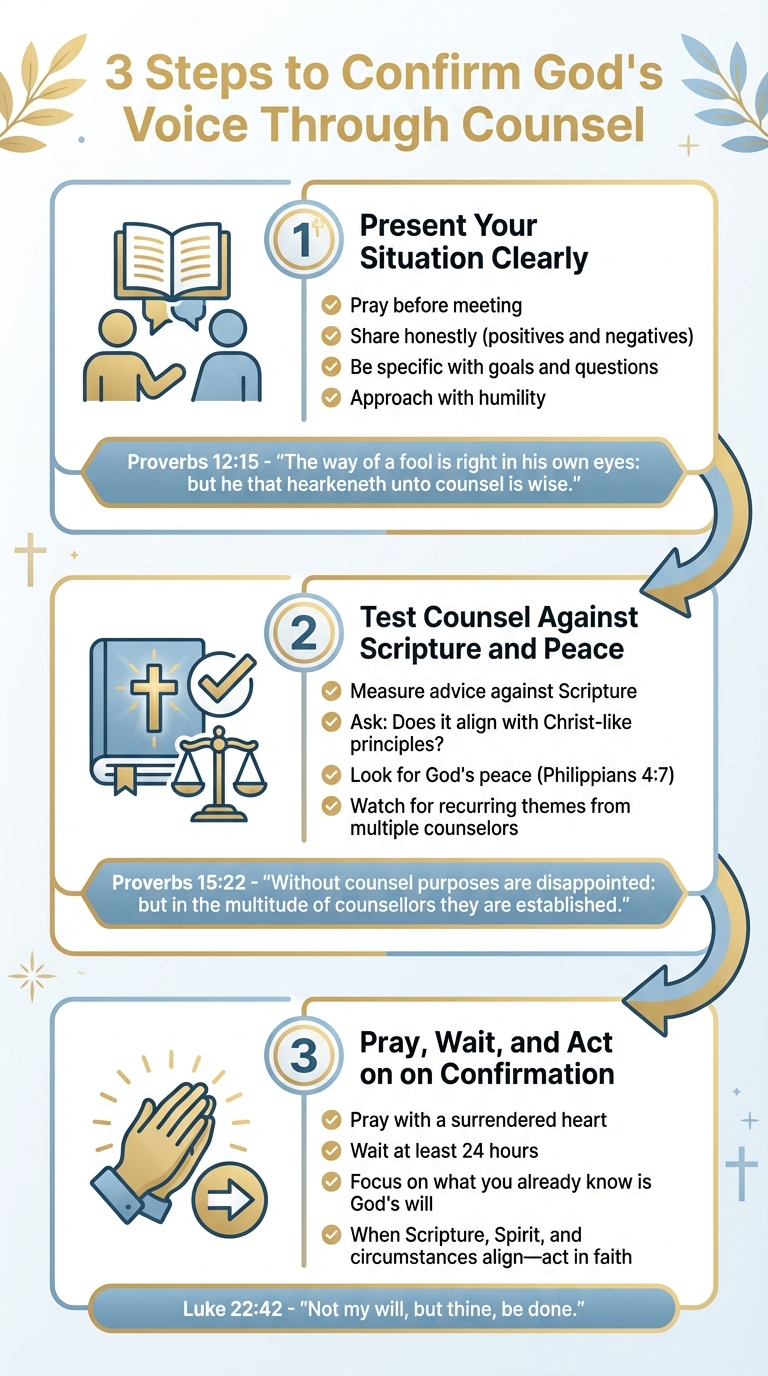
3 Steps to Confirm God’s Voice Through Wise Counsel
Making Counsel a Regular Practice
Seeking wise counsel isn’t just about navigating crises – it’s about cultivating a habit that shapes your character and aligns your choices with God’s will. By regularly turning to biblically grounded advice, you can uncover blind spots, refine your decision-making, and deepen your spiritual walk. Jeff Hagen, President & Founder of Hill Cities, Inc., captures this beautifully:
Wisdom’s a process, not a lightning bolt.
This steady practice not only reinforces God’s guidance but also builds spiritual strength and resilience.
Adding Counsel to Your Daily Life
To truly benefit from purposeful counsel, make it a part of your everyday life. Start by identifying a small circle of 3–5 trusted individuals – elders, mentors, or spiritually mature friends – who exemplify biblical wisdom. Take the first step by inviting an older believer for coffee or directly asking if they’d consider mentoring you. As Kevin Hay, author and contributor at For the Gospel, wisely points out:
If you want wise counsel, don’t wait for someone to notice you. Take initiative.
Consider meeting weekly with these trusted advisors to develop a reliable support system. For example, Hill Cities’ weekly gatherings create spaces where men can connect over shared challenges in family, work, and faith, fostering meaningful, discipling relationships.