


To align your life with God’s will, focus on these seven practical steps:
- Meditate on Scripture Daily: Spend time reading and reflecting on the Bible to understand God’s guidance. Memorizing key verses can help keep His Word central in your daily life.
- Develop a Consistent Prayer Life: Prayer is your direct connection to God. Set aside specific times daily for prayer, and use Scripture as a guide when words feel hard to find.
- Listen for God’s Direction: After praying, take time to sit in silence and listen. Write down impressions or thoughts, and test them against Scripture and wise counsel.
- Trust God’s Timing: Be patient and trust that God’s plans unfold at the right time. Waiting can often be a period of preparation and growth.
- Connect with Other Believers: Build relationships with a faith-based community for accountability, encouragement, and wisdom.
- Act on What God Shows You: When God provides direction, take action without hesitation. Obedience leads to clarity and strengthens your faith.
- Grow in Spiritual Maturity: Focus on becoming more Christlike in character by studying Scripture, praying, and learning from godly mentors.
Each step helps build a deeper connection with God, shaping your decisions and actions to reflect His purpose. Start small – dedicate time daily to Scripture and prayer, and seek support from a faith-based group like Hill Cities to stay on track.
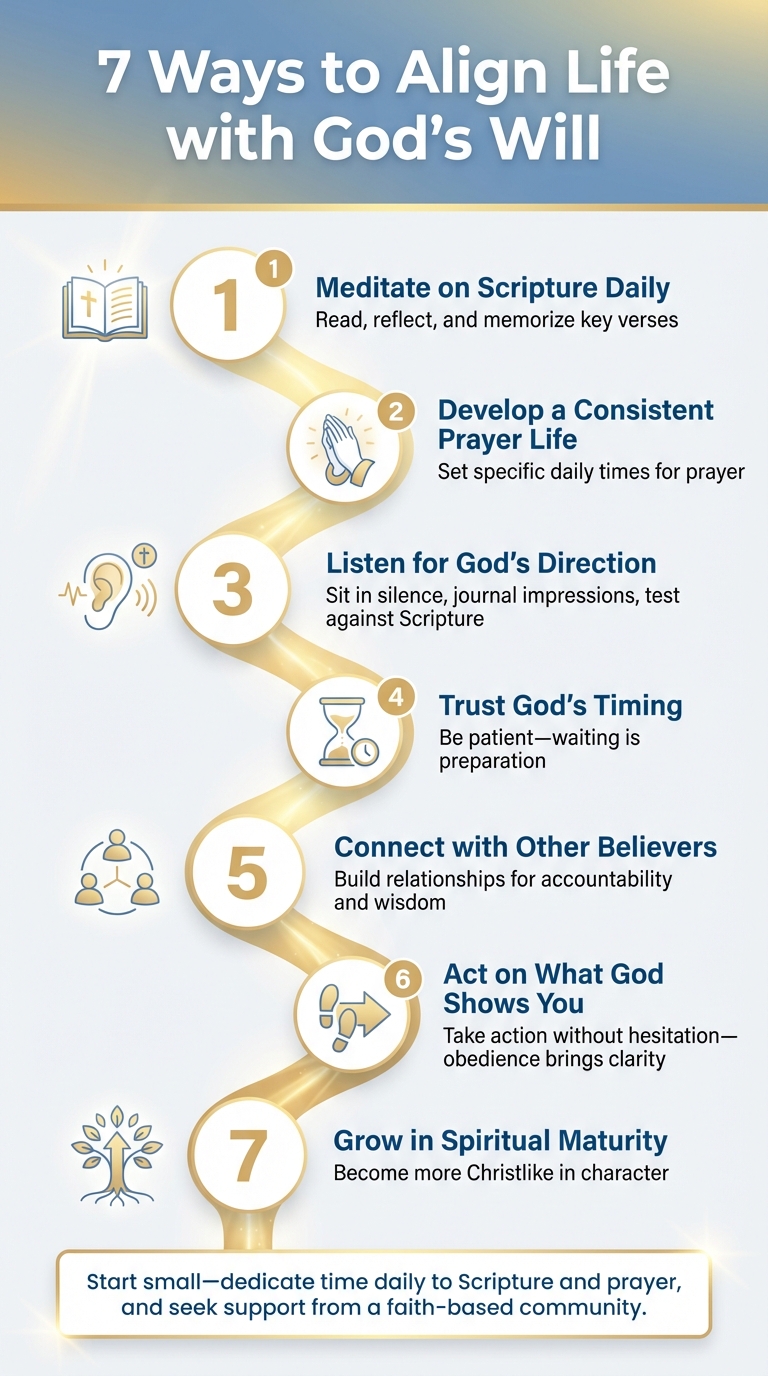
7 Steps to Align Your Life with God’s Will
1. Meditate on Scripture Daily
The Bible serves as a guide to understanding God’s will, offering His commands and principles to shape our lives [2]. Colin Smith, President of Open the Bible, emphasizes this truth:
"God speaks to you directly through His Word. He directs your heart as you read it and meditate on it" [9].
Meditating on Scripture goes beyond simply reading it. In Hebrew, "meditation" conveys the idea of "speaking" or "reciting", encouraging us to internalize God’s Word [12]. A practical method to achieve this is to read a few verses, focus on one key passage, and rephrase its meaning and application in your own words [9].
Memorizing key verses can also help keep God’s Word alive in your heart throughout the day [12]. Tools like Fighter Verses can support this habit. By carrying a single verse with you for several days, you allow time to reflect on its deeper theological and practical meanings before moving on.
Even dedicating just a few minutes each day to Scripture can nourish your soul and establish a lasting habit [9]. Spending time in the Gospels, especially passages like John 13–17, offers profound insights into how Jesus fulfilled the Father’s will [10].
This practice strengthens your spiritual foundation. As Desiring God explains:
"The depth and solidity and certainty of your walk with God and your communion with God will rise and fall with whether God’s own written Word is the warp and woof of the fabric of your fellowship" [12].
When Scripture becomes central to your daily thoughts, discerning God’s will in specific situations becomes much clearer. This clarity also enriches your prayer life and strengthens your relationship with God.
Hill Cities encourages men to incorporate Scripture meditation into their daily routines, fostering spiritual growth and community through gatherings and discussions centered on God’s Word.
sbb-itb-cb63123
2. Develop a Consistent Prayer Life
Prayer isn’t just a ritual – it’s your direct line to God [17]. While meditating on Scripture fills your mind with His truth, prayer turns that understanding into a dynamic, ongoing conversation. As Eugene Peterson puts it:
"Prayer is first of all a means of listening. Prayer is an act of attention" [19].
Scripture meditation prepares your heart, but a consistent prayer routine strengthens that bond. It requires intention and commitment. Biblical figures like David and Daniel prayed three times a day [13][17], showing how setting specific times can anchor your day. For instance, you might dedicate 15 minutes at 6:30 AM to start your mornings with prayer [19]. Use tools like alarms, calendar reminders, or sticky notes to protect this sacred time [14][16].
The focus should be on presence, not perfection. Gene Whitehead explains it beautifully: "Prayer is more about presence than perfection. It’s about showing up, day after day, even when words fall short" [18]. When you struggle to find the right words, lean on Scripture. Prayers like the Psalms or the Lord’s Prayer can guide you and keep the dialogue alive [14][15][17].
You can also transform everyday moments into prayer opportunities. Whether you’re driving, washing dishes, or waiting at a red light, these small windows can become times to connect with God [13][16][18]. This practice builds what some call "spiritual muscle memory", helping you instinctively turn to Him in every situation [18]. Creating a designated prayer space – such as a specific chair or corner – can also serve as a mental cue to focus and slow down [16][17].
Listening is just as important as speaking. Keep a notepad nearby during prayer to jot down any thoughts, questions, or insights that come to mind [2][1]. This quiet, reflective time allows the Holy Spirit to guide you, offering clarity for decisions about your career, family, and daily life. Hill Cities provides resources and weekly gatherings to help you maintain and enrich your prayer habits.
A disciplined prayer life equips you to seek and follow God’s guidance in every aspect of your life.
3. Listen for God’s Direction
Once you’ve established a disciplined prayer life, the next step is learning to listen for God’s direction. Prayer opens the dialogue, but listening completes it. Too often, prayer becomes a one-sided conversation – a list of needs, requests, and concerns – without taking the time to hear God’s response. The Holy Spirit, dwelling within you, serves as your internal guide [21][11], but recognizing His leading requires intentional space and quiet.
Hearing God’s voice isn’t just for moments of crisis or big decisions; it’s a way of life rooted in relationship [3][6]. Jesus put it simply: "My sheep hear My voice, and I know them, and they follow Me" (John 10:27) [20][2]. This means slowing down enough to discern His voice amidst the constant distractions of daily life. God rarely shouts over the noise; instead, He speaks in the stillness. Creating time for quiet reflection is essential.
To help with this, try active listening during your prayer time. After sharing your thoughts and concerns, sit in silence for a few minutes. Bring a journal and write down specific questions at the top of the page – questions like, "What’s the next step in my career?" or "How should I approach this relationship?" Then, jot down any thoughts or impressions that come to mind. This practice creates space for the Holy Spirit to guide you. Always test these impressions against Scripture [3][11]. If they promote love, peace, and Christlike character, they are more likely to be from God [10].
To confirm what you sense, rely on Scripture, prayer, wise counsel, and circumstances [21][3]. When you feel a spiritual nudge, take a moment to pause before acting. Share these impressions with trusted mentors – just as Samuel sought guidance from Eli [20] – to gain an objective perspective. Pay attention to what some call the "umpire of peace." If a decision aligns with Scripture and wise counsel but you still lack inner peace, it may be a sign to wait for God’s timing [22][3].
It’s also important to let go of personal bias when seeking direction. As R.B. Ouellette explains:
"God shows me His will so I may live in compliance with it… God doesn’t have the responsibility to tell me His will so I may examine it, discuss it with Him, and decide whether or not I wish to follow it" [22].
Approach God with a heart ready to follow wherever He leads, rather than seeking confirmation for plans you’ve already made [21][6]. As you grow in this practice, consider discussing and refining your insights during weekly Hill Cities gatherings. These gatherings provide a space to sharpen your spiritual discernment alongside other men who are also learning to hear God’s voice in their daily lives.
4. Trust God’s Timing
Once you’ve learned to listen for His guidance, the next step is trusting in His perfect timing. This is where many people falter – not because they can’t hear God, but because waiting on Him can be challenging. Interestingly, about 98% of God’s will is already laid out in Scripture [5]. The uncertainty we often face isn’t so much about what to do but when to do it.
Think of God’s guidance like an old-fashioned oil lamp that lights only your next step. As R.B. Ouellette puts it:
"God doesn’t always tell us His long-range plan for us. But He will let us know, step by step, what He wants us to do" [22].
You don’t need to see the entire journey ahead – just trust Him with the next step. This requires patience and faith, knowing that God sees the bigger picture you can’t.
Delays are not accidents; they are part of God’s design [6]. Take Joseph, for example. He had a dream about leading others, but it took 13 years – and trials like slavery and imprisonment – before his vision became reality [24]. David, too, was anointed as king but waited roughly 20 years to take the throne [24]. These waiting periods weren’t wasted time; they were seasons of preparation, shaping their character and readiness.
Pay attention to the peace – or lack thereof – you feel when making decisions. Ken Boa offers wise counsel:
"The option may be right, but the timing may be wrong" [3].
Even if a decision aligns with Scripture and advice from wise counselors, if you don’t feel inner peace, it’s a sign to wait. Trust that when the timing is right, everything will align. Pastor William Chung captures this beautifully:
"It just happens. You don’t need to force it, you don’t need to make it happen; God makes it happen" [24].
This sense of peace reassures you that while you wait, your relationship with God remains vital.
In the meantime, focus on what God has already revealed: pray, dive into Scripture, avoid sin, and love those around you [4]. As the saying goes, God can’t steer a stationary ship [23]. Keep moving forward with the tasks He has given you, knowing that if the next step isn’t clear yet, it may be because you’re not finished with where you are now.
5. Connect with Other Believers
As you trust in God’s timing, one of the most powerful ways to strengthen your spiritual journey is by connecting with others who share your faith. Walking this path alone isn’t how God intended it. Instead, He designed us to grow in relationship with fellow believers [25]. While American culture often celebrates individualism, the Bible encourages us to lean on others for wisdom, support, and encouragement.
Scripture reminds us of this truth: "Where there is no counsel, the people fall; but in the multitude of counselors there is safety" [10]. When you’re seeking to understand God’s will, the insight of mature believers can provide both guidance and correction. As Ken Boa explains:
"The perspective of mature and godly people can be instructive and corrective. Even the wisest people are finite and biased, though, and we ultimately bear the responsibility for our decisions" [3].
Sometimes, those around you can see your spiritual gifts and calling more clearly than you can. Steve Brown captures this idea perfectly:
"We, as Christians, weren’t meant to do this thing on our own. In fellowship with other Christians, God has given us the corrective that is needed in discerning his will" [7].
To put this into practice, consider joining a community where you can grow spiritually and be held accountable. Start small – find a Bible study or a group where you can share openly and build meaningful connections. For instance, the MANUP ministry organizes weekly gatherings focused on fellowship, Bible study, and open discussions [8]. Similarly, organizations like Hill Cities offer free weekly gatherings to help believers form deep spiritual relationships.
Don’t stop at Sunday services. Look for ways to engage actively throughout the month – volunteer, join a small group, or simply check in with a fellow believer. It’s worth noting that 85% of churches report they lack the resources to launch a men’s ministry [8]. Your involvement could make a real difference in building a supportive community.
6. Act on What God Shows You
Once you’ve prayed and listened, the next step is to take action. When God reveals the path forward, it’s important to act without hesitation. A powerful example of this can be found in Acts 16:6–10. Paul and his companions faced repeated barriers from the Holy Spirit as they attempted to enter Asia and Bithynia. Then, Paul had a vision of a man in Macedonia pleading for help. Without delay, they set out for Macedonia, which ultimately allowed the gospel to spread across Europe and eventually to Rome [1].
Delaying obedience can hinder further guidance. As Chris Russell, Pastor at Veritas Church, points out:
"God will likely be slow to show you His plan if He knows you will likely not do that plan anyway" [1].
In other words, responding to God’s clear commands in Scripture is key to receiving further direction. Obedience serves as the bridge between hearing God’s prompting and stepping forward in faith.
God’s will is revealed for immediate action, not for debate. As R.B. Ouellette explains:
"God doesn’t have the responsibility to tell me His will so I may examine it, discuss it with Him, and decide whether or not I wish to follow it. God shows me His will so I may live in compliance with it" [22].
This means committing to follow God’s guidance even before seeking additional direction [6].
Start with what is already clear. Scripture provides a solid foundation, outlining much of God’s will – commands to avoid immorality, love others, and practice gratitude [1]. Following these principles strengthens your ability to make larger, faith-filled decisions. Ken Boa, President of Reflections Ministries, emphasizes:
"This habit of taking God seriously in small decisions will make major decisions less traumatic" [3].
After praying, studying Scripture, and seeking wise counsel, move forward with confidence [6]. As Sarah Christmyer wisely notes:
"God can’t steer a ship that’s not moving" [23].
And if you make a mistake while sincerely trying to follow God, trust in His providence to guide you back on course [26].
Surrounding yourself with a supportive community can help you stay committed to acting on what God reveals. For encouragement and resources, consider joining a group that fosters spiritual growth. Hill Cities offers free weekly gatherings, tools, and discussions to help you align your life with God’s will.
7. Grow in Spiritual Maturity
Living in alignment with God’s will isn’t just about knowing what He wants you to do – it’s about becoming more like Christ in your character. As Ken Boa, President of Reflections Ministries, puts it:
"God’s primary will has already been revealed to us in His Word: to form and forge a Christlike character in us" [3].
Start by taking a close look at your character through the lens of Scripture. Think of the Bible as a mirror that reflects the gap between who you are now and who God calls you to be. Passages like the Sermon on the Mount (Matthew 5–7), the fruit of the Spirit (Galatians 5:22–23), and the qualifications for elders in 1 Timothy 3:1–7 can serve as benchmarks for this self-assessment [27]. This honest evaluation helps highlight areas in your life that need growth and transformation.
As you deepen your habits of reading Scripture and praying, shift your focus from seeking recognition for yourself to glorifying God in all you do. Desiring God reminds us:
"Godliness will make you happier than the satisfaction of any earthly desire" [27].
This shift in perspective happens through daily choices – rejecting worldly ideas and allowing the Holy Spirit to reshape your mind and priorities [10].
Spiritual growth also thrives in community. Surround yourself with godly mentors – those whose lives reflect holiness and joy. Observing and learning from mature believers can accelerate your journey. True spiritual maturity means moving beyond simply consuming advice to becoming someone who offers wisdom and guidance to others [27].
To build consistency, carve out 20–30 minutes each morning for Scripture and prayer. Ask reflective questions like, "What can I praise God for in this passage?" or "What sins does this reveal in my life?" [27]. These small, daily habits lay the groundwork for making bold, faith-filled decisions with confidence. If you’re looking for additional encouragement, Hill Cities hosts free weekly gatherings where you can connect with others on this journey.
Conclusion
Living in alignment with God’s will isn’t something reserved for moments of crisis – it’s about nurturing a daily connection with Him through Scripture, prayer, and community. Ken Boa, President of Reflections Ministries, puts it beautifully:
"Discerning God’s will is a process, a way of life, centering not on some special, all-purpose technique or program, but on our relationship with God" [3].
This journey is about transformation – allowing your decisions and desires to reflect His. When you commit to studying His Word, listening in prayer, and seeking guidance from others who walk in faith, your heart begins to want what He wants. It’s not about begrudging obedience; it’s about becoming someone who naturally delights in His plans.
Here’s something to consider: if God made His will clear to you today, would you follow it? Your answer can reveal where your heart stands. If there’s hesitation, bring that reluctance to Him – He’s ready to help you work through it.
And remember, this isn’t a solo journey. Spiritual growth flourishes in community. Hill Cities offers free weekly gatherings where men can find accountability, encouragement, and wisdom to live in step with God’s will.
Why not take a small but meaningful step today? Dedicate 20 minutes to Scripture and prayer, reach out to a mentor, or connect with a faith-based group. As you embrace these practices daily, you’ll find yourself standing more firmly in the center of God’s will, trusting that He is revealing His plan for your life. Let your actions reflect His purpose, one step at a time.
FAQs
How can I make Scripture meditation a regular part of my daily life?
To make Scripture meditation a regular part of your day, carve out a specific time each morning and evening. Choose a quiet spot where you can focus without interruptions. Start with a short passage or verse – perhaps a Psalm or a line from Joshua – and read it slowly. Let the words resonate, giving yourself time to absorb their meaning. Think about what the passage reveals about God’s nature or how it relates to your own life, and consider jotting down your reflections in a journal.
Follow this with prayer, asking God for wisdom and strength to live out what you’ve read. Sharing your insights with a faith-focused group, like a Hill Cities community, can offer encouragement and help you stay accountable as you develop this practice. With consistency, this daily meditation can deepen your spiritual growth and help you align your actions with God’s purpose.
How can I strengthen my prayer life and stay consistent?
Strengthening your prayer life begins with making it a regular part of your day. Choose a specific time – whether it’s in the morning, during a lunch break, or before bed – and treat it as a commitment you won’t skip. Find a quiet spot where you can focus without distractions, and consider keeping a prayer journal. Writing down your requests, answered prayers, or recurring thoughts can help you approach prayer as a meaningful and intentional conversation with God.
Building consistency becomes easier when you’re part of a supportive community. Joining a men’s group, like the weekly gatherings hosted by Hill Cities, can offer encouragement, accountability, and the chance to pray with others. You could also team up with a prayer partner or use simple tools like a prayer list to stay organized. Like any habit, prayer takes practice. Set reminders, celebrate small steps forward, and enjoy the journey as you grow closer to God.
How can I understand God’s guidance when making important life decisions?
Understanding how to follow God’s guidance begins with a heart fully open and surrendered to Him, paired with a willingness to obey His lead. The Bible encourages us to present ourselves as living sacrifices (Romans 12:1-2) and to approach Him with humility, seeking His direction (Psalm 25:4-5). Instead of expecting instant answers, focus on nurturing a close relationship with God through prayer, studying Scripture, and being attentive to the Holy Spirit.
Start by praying for wisdom and clarity, trusting that God generously provides guidance to those who genuinely ask (James 1:5-6). Make sure your choices align with biblical principles, as God’s Word is a dependable source of direction (Psalm 119:105). It’s also wise to seek counsel from trusted, faith-filled friends who can offer valuable perspectives (Proverbs 15:22). Lastly, pay attention to the peace of the Holy Spirit, which often serves as confirmation when you’re on the right path (Philippians 4:7).
If you’re searching for a community to support your spiritual growth and help you make decisions rooted in faith, Hill Cities hosts weekly gatherings. These meetings provide an opportunity to connect with other men, explore Scripture together, and find encouragement as you strive to align your life with God’s will.