

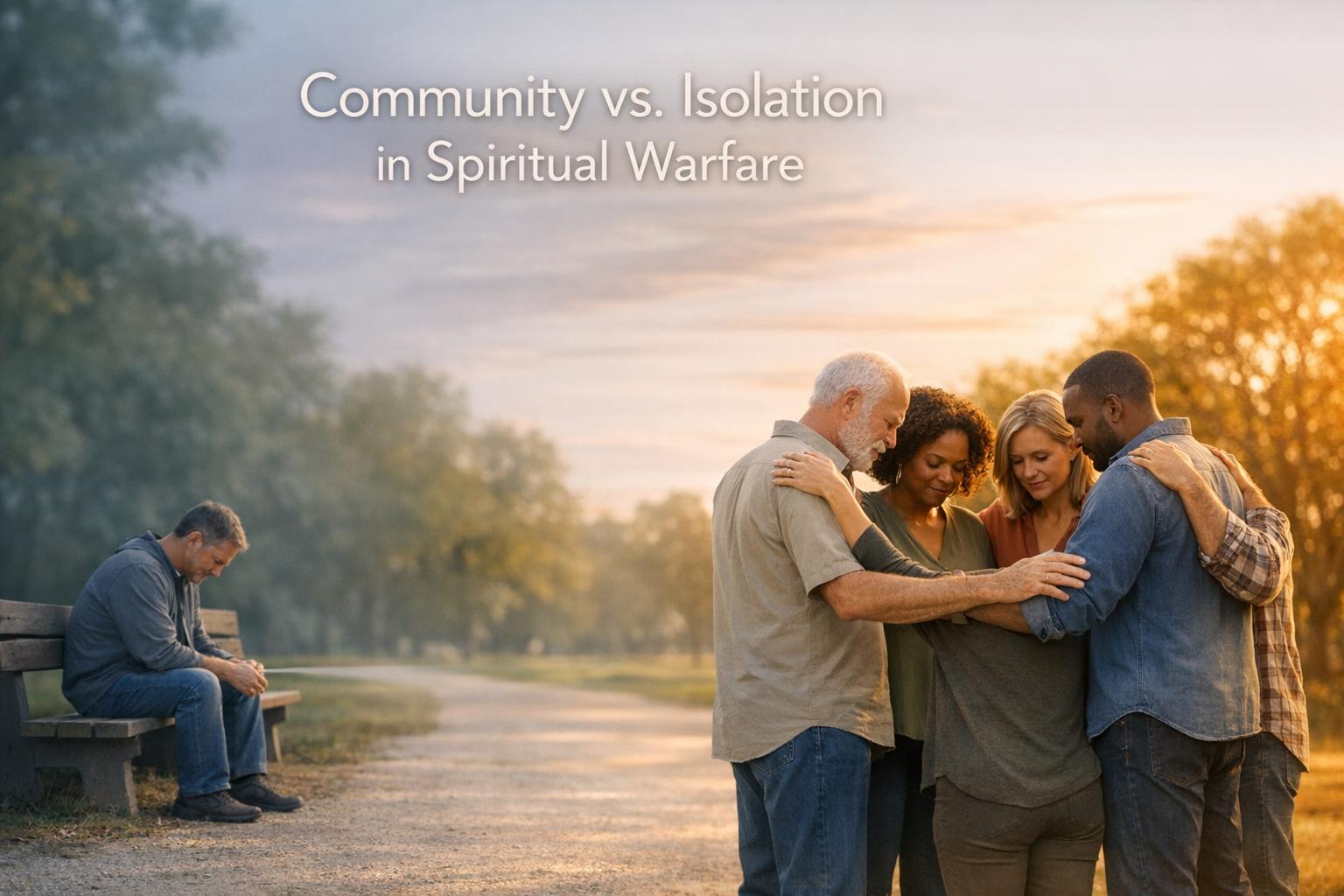
Facing spiritual battles alone leaves you vulnerable, while being part of a community provides strength, support, and resilience. The Bible repeatedly emphasizes the importance of fellowship in overcoming challenges, highlighting how isolation weakens faith and exposes believers to temptation and discouragement.
Key takeaways:
- Isolation weakens: It drains spiritual strength, amplifies negative thoughts, and leaves you unprotected. Proverbs 18:1 and Ecclesiastes 4:10 warn against going it alone.
- Community strengthens: Fellowship offers accountability, shared faith, and mutual encouragement. Ecclesiastes 4:12 and Hebrews 10:24-25 stress the power of unity.
- Biblical examples: Stories like Moses’ battle with the Amalekites (Exodus 17:10-13) show how teamwork leads to victory.
The choice is clear: stand alone and risk defeat, or join a community to grow stronger together.
The Dangers of Fighting Spiritual Battles Alone
How Isolation Increases Spiritual Weakness
Trying to face spiritual battles on your own leaves you exposed and vulnerable. The Bible is clear on this: "Whoever isolates himself seeks his own desire; he breaks out against all sound judgment" (Proverbs 18:1) [6]. Think of it like pulling a single coal from a blazing fire – without the warmth of fellowship, that coal cools quickly. In the same way, isolation drains your spiritual strength. Without the encouragement and accountability that come from being part of a community, it becomes easier to fall into doubt and temptation [7].
Billy Robbins from Intent Man puts it bluntly:
"Lions don’t attack the pack – they attack the one who’s isolated" [10].
This analogy captures the enemy’s strategy perfectly. Those who separate themselves from others lack the protection and support that comes from unity. Beyond the spiritual toll, isolation also weighs heavily on the mind and emotions.
The Mental and Emotional Toll of Isolation
Isolation doesn’t just weaken your spirit – it also takes a toll on your mental and emotional health. Garrett Higbee, Director of Lead Healthy Retreats, explains:
"Loneliness tends to exaggerate negative thinking and behavior. It is like an echo chamber of our worst fears that drowns out wisdom" [8].
Without the perspective and truth that others can provide, negative thoughts grow louder, feeding into cycles of discouragement and despair.
Carrying spiritual burdens alone often leads to exhaustion and burnout. When prayer, worship, and Bible study are neglected, feelings of hopelessness and worry can take over [9]. Even those who lean toward introversion aren’t immune – extended isolation can stir up inner battles of fear, doubt, and insecurity [7]. Without accountability, it becomes easier to give in to temptation or seek comfort in unhealthy ways [9].
Biblical Warnings About Isolation
The Bible consistently warns against going it alone. Ecclesiastes 4:10 reminds us:
"If either of them falls down, one can help the other up. But pity anyone who falls and has no one to help them up" [5].
The idea of standing alone isn’t celebrated in Scripture – it’s called out as dangerous and unwise.
Take the story of Moses during the battle with the Amalekites. When he tried to keep his staff raised by himself, he grew too tired, and Israel began to lose. But when Aaron and Hur stepped in to support him, the Israelites turned the tide and won the battle (Exodus 17:10-13) [4]. The message is clear: you weren’t created to fight alone.
Matthew T. Adams, author of My Reasons To Believe, sums it up well:
"Isolation makes us weak. Brotherhood makes us dangerous" [5].
The enemy thrives on isolation, using it to exhaust and deceive you into thinking no one cares or understands. Don’t give him that foothold. These warnings emphasize why facing spiritual battles within a community offers so much more strength and resilience.
sbb-itb-cb63123
How Community Strengthens Spiritual Warfare
The Advantage of Fighting Together
Community serves as a powerful antidote to the dangers of isolation. Ecclesiastes 4:12 illustrates this beautifully: "Though one may be overpowered, two can defend themselves. A cord of three strands is not quickly broken" [5]. Just as a tightly woven cord resists breaking, believers united in prayer create a strength that is hard to overcome. Spiritual warfare thrives on collective effort. When two or three come together in Jesus’ name, His presence is promised in their midst (Matthew 18:20) [12]. This unity doesn’t just multiply human strength – it invites Christ Himself into the battle. Picture the ancient Roman testudo formation, where soldiers locked their shields together to create an impenetrable barrier. Similarly, when believers stand together, they can withstand attacks that would easily overpower an individual [1].
Accountability and Shared Faith
One of the greatest advantages of community is the accountability it fosters. Accountability partners act like watchmen, helping you recognize dangers you might not see on your own [13]. Real Life Ministries exemplifies this principle, having established around 100 new discipleship groups to ensure mutual support and expand outreach despite challenges [1].
Groups like Hill Cities also understand the importance of connection. Through weekly meetings and small group discussions, men build relationships grounded in honesty and shared faith. These gatherings create spaces for individuals to share struggles, join in prayer, and grow through genuine conversations. This reflects the wisdom of Proverbs 27:17: "As iron sharpens iron, so one person sharpens another" [11].
Biblical Examples of Community
The importance of community is deeply rooted in Scripture. Hebrews 10:24-25 urges believers to "consider how to stir up one another to love and good works, not neglecting to meet together, as is the habit of some, but encouraging one another" [11]. This call to gather and uplift one another is critical for spiritual endurance. Jesus Himself modeled this by sending His disciples out in pairs (Mark 6:7) [11]. Additionally, the New Testament contains over 40 "one another" commands, which encourage believers to love, serve, and support each other. These commands highlight that fellowship isn’t just helpful – it’s essential for the Church to thrive.
Pastor Ethan Wormell of Forestdale Church captures this idea perfectly:
"A properly equipped soldier not only defends himself; he also defends and protects others" [2].
Being part of a community strengthens not only your own spirit but also those of the people around you. The combined power of biblical teaching and practical accountability shows that community is one of the most effective tools in spiritual warfare.
Bible Verses: Community vs. Isolation
Warnings About Isolation
The Bible provides clear cautions about the risks of isolation. Proverbs 18:1 warns, "Whoever isolates himself seeks his own desire; he breaks out against all sound judgment." This verse emphasizes how separating oneself can lead to spiritual vulnerability, cutting off the wisdom and guidance needed to remain steadfast in faith.
Ecclesiastes 4:9-10 offers a vivid reminder of why isolation is dangerous: "Two are better than one, because they have a good return for their labor: If either of them falls down, one can help the other up. But pity anyone who falls and has no one to help them up." Without the support of others, believers risk being left unprotected during times of struggle. Similarly, Genesis 2:18 highlights that humans were never meant to live in solitude, stating, "It is not good for the man to be alone." These warnings make it clear: isolation weakens both our spiritual and emotional defenses.
The Blessings of Community
On the other hand, the Bible celebrates the strength and healing found in fellowship. James 5:16 ties community directly to spiritual restoration: "Confess your sins to each other and pray for each other so that you may be healed. The prayer of a righteous person is powerful and effective." Through mutual confession and prayer, believers find both healing and encouragement.
Matthew 18:19-20 offers a powerful promise about the presence of Christ in community: "For where two or three gather in my name, there am I with them." Similarly, Ecclesiastes 4:12 paints a compelling picture of the strength found in unity, saying, "A cord of three strands is not quickly broken." Together, these verses illustrate how fellowship fortifies believers against spiritual challenges.
David Mathis, Executive Editor at Desiring God, captures the essence of community beautifully:
"A brother who knows me as me, and not as another generic human, can speak the truth in love… with specificity into my life."
This kind of deep, personal accountability is only possible within a genuine community. The message is clear: standing together in faith not only shields us but empowers us to thrive in our spiritual journey.
Community vs. Isolation: A Direct Comparison
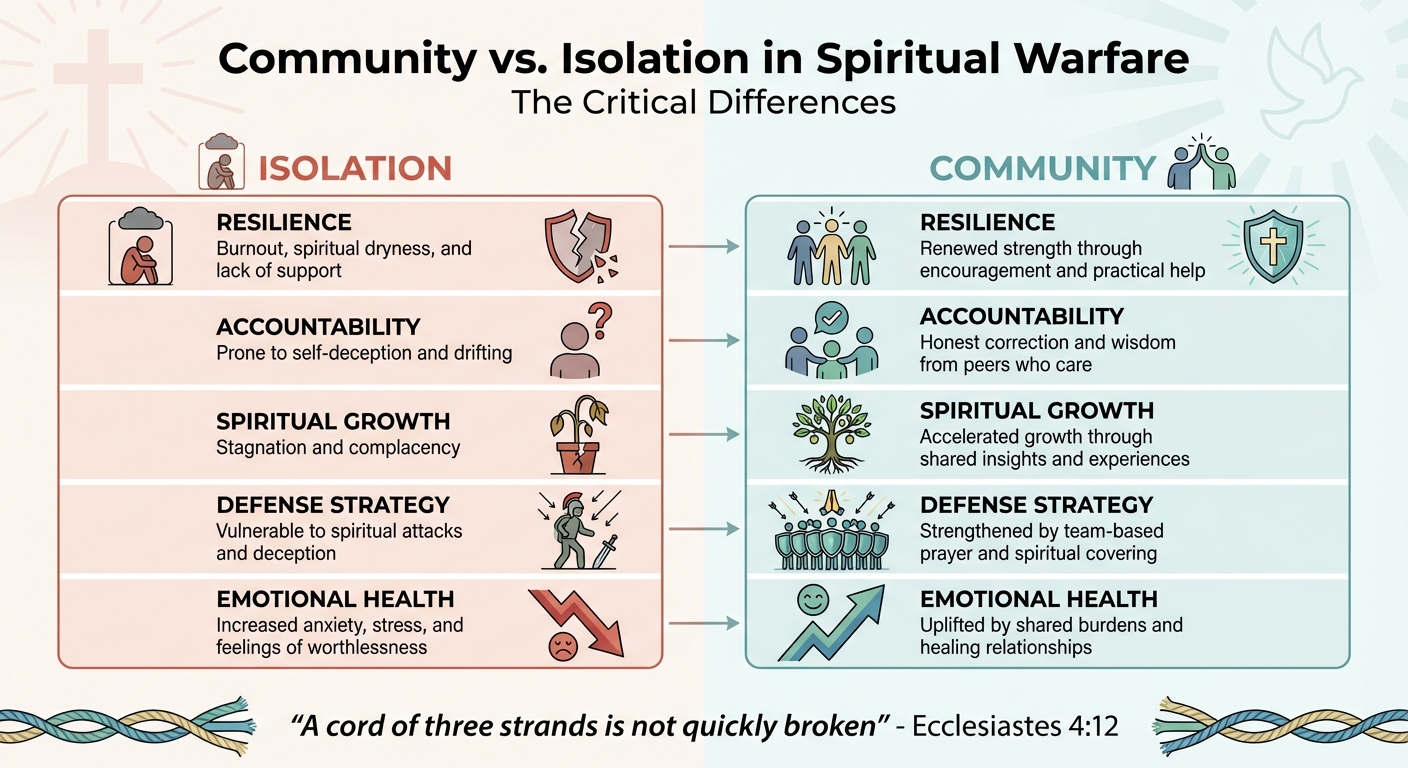
Isolation vs Community in Spiritual Warfare: Key Differences
The difference between facing spiritual challenges alone versus within a community is stark – it’s the gap between vulnerability and strength. Let’s dive into three key areas where this contrast becomes especially clear: resilience, accountability, and spiritual growth.
Resilience takes a major hit in isolation. Col. Tim Hale, USAF (Ret.), describes resilience as "the ability to bounce back after mental, physical, spiritual, moral, and complex injuries" [15]. When you’re on your own, burnout and spiritual exhaustion creep in faster, and there’s no one to catch you when you falter. On the flip side, being part of a supportive community helps you recover when you’re worn down. Trusted friends step in with encouragement and practical support. The effects of isolation aren’t just emotional – they’re physical too, with links to higher risks of heart attacks, strokes, chronic inflammation, depression, and anxiety [15].
Accountability also looks completely different depending on whether you’re alone or surrounded by others. When you’re isolated, it’s easy to fall into self-deception and stray from sound judgment. But in a community, accountability thrives. As the saying goes, “iron sharpens iron” – peers provide perspective, wisdom, and the honest correction you need to stay on track [6][11]. Pastor Jim Putman of Real Life Ministries offers a powerful example. When pride and anger tempted him to leave his church, he found himself distancing from Christ and his leadership team. It was only through the accountability of his fellow elders that he overcame this struggle. Together, they not only restored his path but also achieved remarkable growth, including building a massive sports complex, three full-sized gyms, and launching 30 new relational discipleship groups in just one year [1].
Spiritual growth thrives in the right environment. Alone, faith can stagnate and grow cold, becoming vulnerable to complacency. In a community focused on “spiritual fitness,” however, shared gifts, insights, and collective obedience create fertile ground for growth [14][11]. The difference is night and day: isolation leads to a faith that barely survives, while community fosters a vibrant and flourishing relationship with God.
Here’s a quick snapshot of these contrasts:
| Area | Isolation | Community |
|---|---|---|
| Resilience | Burnout, spiritual dryness, and lack of support | Renewed strength through encouragement and practical help |
| Accountability | Prone to self-deception and drifting | Honest correction and wisdom from peers who care |
| Spiritual Growth | Stagnation and complacency | Accelerated growth through shared insights and experiences |
| Defense Strategy | Vulnerable to spiritual attacks and deception | Strengthened by team-based prayer and spiritual covering |
| Emotional Health | Increased anxiety, stress, and feelings of worthlessness | Uplifted by shared burdens and healing relationships |
The takeaway is clear: isolation weakens every aspect of spiritual life, while community provides the strength and support needed to thrive.
At Hill Cities, we’re passionate about building authentic communities. Through accountability, shared faith, and mutual encouragement, we empower men to break free from isolation, build resilience, and grow deeper in their spiritual journey.
Why Community Wins in Spiritual Warfare
When it comes to spiritual warfare, the importance of community can’t be overstated. It’s not just helpful – it’s essential. Scripture consistently highlights the power of unity when facing spiritual challenges. Take Ecclesiastes 4:12 as an example: "Though one may be overpowered, two can defend themselves. A cord of three strands is not quickly broken" [16][3]. Even Jesus emphasized this principle by sending His disciples out in pairs (Mark 6:7), showing that faith was never meant to be a solo endeavor [5]. Paul’s description of the armor of God in Ephesians 6 further reinforces this, portraying the church as a united body – a spiritual "platoon" designed to stand together, not apart [2][1].
This isn’t just a spiritual ideal; it’s a practical reality. History is full of examples where unity provided strength against overwhelming odds [1]. Spiritually, the same holds true. When believers join together, they form a protective barrier against attacks. Pastor Jim Putman has pointed out that fighting alone only intensifies vulnerability. The enemy thrives on isolation, but community turns weakness into strength, making individuals far more resilient in the battle [5][1].
The impact of a unified approach is clear in real-world examples. Pastor Jim Putman and the leadership at Real Life Ministries in North Idaho experienced this firsthand. After struggling with internal conflict, they shifted their focus from individual efforts to a collective vision. The results were transformative: they built strong facilities, launched 30 discipleship groups, and mentored 68 local youths – all achieved through the power of community [1]. Stories like these highlight what’s possible when people choose unity over isolation.
Hill Cities embodies this idea, creating a space for men to experience the strength of authentic community. Through weekly gatherings, open discussions, and practical resources, Hill Cities helps men break free from the "lone wolf" mentality. It’s a place where accountability, shared faith, and mutual encouragement thrive, giving men the tools they need to stand firm together.
As Tim Bergmann, Lead Pastor at Alliance Community Church, wisely said:
"I’d rather appear weak, need community, and be successful than to appear strong, shun community, and fail miserably" [16].
The reality is, everyone will need support at some point. The choice is clear: face the battle alone and risk vulnerability, or embrace the strength, protection, and growth that only community can provide. Don’t wait until it’s too late to reach out.
FAQs
How do I know if I’m drifting into unhealthy isolation?
If you find yourself viewing your faith as something entirely private, avoiding genuine fellowship with others, or using social interactions as a way to distract yourself rather than deepen your connection with Christ, it might be a sign you’re slipping into unhealthy isolation. Take a moment to reflect: Are your relationships helping you grow spiritually, or are they unintentionally keeping you from a deeper faith?
What should I do if I don’t have a trusted faith community yet?
Community plays a key role in fostering spiritual growth and resilience, particularly during times of spiritual challenges. A great first step is to connect with local churches, small groups, or faith-based organizations like Hill Cities, which emphasize fellowship and spiritual development. Consider joining prayer groups, Bible studies, or weekly gatherings to form meaningful connections with others who share your faith. If you’re not sure where to start, look into local or online faith-based events to discover a supportive community that aligns with your spiritual path.
How can I find accountability without feeling exposed?
Building accountability without feeling vulnerable begins with creating trust in relationships that feel secure and supportive. Close, one-on-one connections – like having a "battle buddy" – offer a space for open, honest conversations while respecting personal boundaries. Similarly, small faith-based groups can serve as a safe haven for mutual encouragement and personal growth. The goal is to nurture trust and honesty, making accountability an uplifting experience centered on support rather than criticism.