

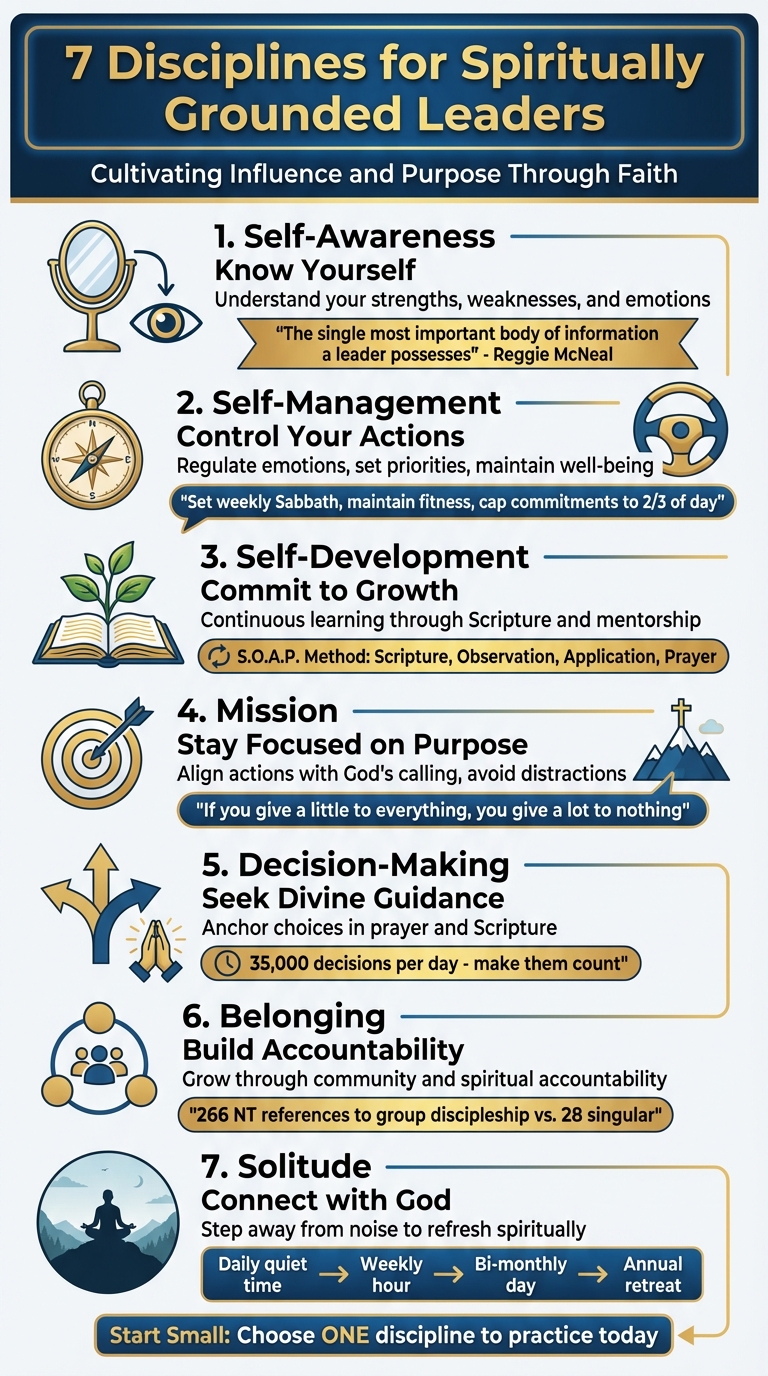
Effective leadership requires a strong spiritual foundation. Without it, leaders risk burnout, poor decision-making, and a loss of integrity. Reggie McNeal highlights seven key disciplines that help leaders stay spiritually grounded and lead with purpose. These practices focus on personal growth, self-regulation, and alignment with a higher mission. Here’s a quick overview of the disciplines:
- Self-Awareness: Understand your strengths, weaknesses, and emotions.
- Self-Management: Act on self-awareness by regulating emotions and setting priorities.
- Self-Development: Commit to continuous learning and spiritual growth.
- Mission: Stay focused on your purpose and avoid distractions.
- Decision-Making: Seek divine guidance and Scripture to make wise choices.
- Belonging: Build accountability and connection through community.
- Solitude: Step away from distractions to connect deeply with God.
These habits shape leaders’ character and ensure their actions align with their values and faith. Start small by incorporating one discipline into your daily routine and grow from there.
7 Spiritual Disciplines for Effective Leadership
1. Self-Awareness
Self-awareness forms the bedrock of effective spiritual leadership. Reggie McNeal captured its importance perfectly when he said, "The discipline of self-awareness – the single most important body of information a leader possesses." [1] Without it, leaders can face unnecessary obstacles and even undermine their own efforts. [2]
The Apostle Paul emphasized this idea in 1 Timothy 4:16: "Keep a close watch on how you live and on your teaching. Stay true to what is right for the sake of your own salvation and the salvation of those who hear you." [2]
sbb-itb-cb63123
2. Self-Management
Knowing yourself is one thing, but how you act on that knowledge is what truly defines self-management. Reggie McNeal describes this as the ability to regulate emotions, set clear expectations, and prioritize both mental and physical well-being [5]. Without this discipline, even the most self-aware leaders risk becoming reactive, losing their focus and spiritual vitality. In essence, self-management turns internal understanding into purposeful action.
It’s no secret that emotions heavily influence thoughts and behaviors. For example, anger can derail thoughtful decision-making. Virginia Holeman highlights this by saying:
Self-control assists ministry leaders to manage difficult conversations or confrontations with greater emotional calm [9].
This journey often involves intentionally transitioning from an "old self" to a "new self" through deliberate emotional regulation [9].
Think of a leader’s strength like an iceberg – what’s visible is only a fraction of the whole. Much of their resilience and effectiveness comes from unseen personal disciplines. Leaders grounded in spiritual practices, like those nurtured at Hill Cities, are reminded that their true foundation lies in private habits, not just public accomplishments [8]. Andy Crouch offers a cautionary perspective:
Without spiritual practices to guard against the unique temptations of public life, we will likely drift into narcissism and exploitation [8].
Practical steps for self-management can include: setting aside a weekly Sabbath, maintaining physical fitness with at least three weekly workouts, finding a trusted person to review financial habits, and capping public commitments to two-thirds of the day [6][7][8]. Dallas Willard exemplified this discipline when he shared:
I was practicing the discipline of not having to have the last word [3].
These habits are more than just routines – they serve as the foundation for personal growth and transformation. By mastering self-management, leaders strengthen their integrity and enhance their spiritual impact.
3. Self-Development
In addition to self-awareness and self-management, ongoing personal growth is essential for leaders to maintain their moral and spiritual grounding, especially during challenging times. As N.T. Wright explains:
"Reading and studying scripture has been seen as central to how we are to grow in the love of God; how we come to understand God and His truth more fully; and how we can develop the moral muscle to live in accordance with the gospel of Jesus even when everything seems to be pulling the other way." [10]
Scripture serves as both a source of inspiration and a practical guide for leadership. For example, Billy Graham followed a daily practice of reading five Psalms and one chapter of Proverbs. This routine helped him anchor his leadership in worship and wisdom, providing a solid foundation to withstand the pressures of public ministry [6].
Leaders looking to grow spiritually should distinguish between simply reading scripture and deeply studying it. While reading offers nourishment and familiarity, studying allows for deeper understanding and practical application. A helpful tool for this is the S.O.A.P. method: writing out a passage of Scripture, making observations about its meaning, identifying personal applications, and concluding with prayer. This approach helps transform knowledge into actionable steps [6].
Another key aspect of self-development is mentorship. Seeking guidance from a trusted mentor who can provide honest feedback is invaluable. A mentor not only helps leaders stay grounded but also ensures they don’t lead in isolation. Programs like Hill Cities offer weekly gatherings and discussions, creating opportunities for mentorship and accountability.
Ultimately, self-development is an ongoing journey. Whether through memorizing scripture, engaging with a mentor, or participating in faith-based learning opportunities, leaders who prioritize their growth cultivate the spiritual strength needed to lead with integrity, even in the face of adversity.
4. Mission
A clear mission helps leaders stay focused on what God has called them to do, steering them away from personal ambition. As John Piper puts it:
Spiritual leadership means discerning God’s destination for people and actively using His methods and power to reach it [4].
Without this clarity, leaders risk overcommitting or pursuing impressive opportunities that don’t align with their divine purpose.
The most effective missions are often simple and concise. For example, in March 2023, First Baptist Church De Soto, under the leadership of Pastor Brad Delaughter, articulated its mission as: "exalt Christ, equip disciples, and engage the world." This mission became a lens through which every program was evaluated – programs that didn’t align were either restructured or discontinued [12]. This approach avoids what some call the "Cheesecake Factory" dilemma: offering too many options, which can overwhelm rather than provide clear direction [11]. A focused mission like this fuels passionate and purposeful ministry.
Discovering your mission often starts with a sense of "holy restlessness" – a dissatisfaction with the status quo that sparks a desire for growth and change [4]. Reflect regularly by asking:
What is the one thing God has called me to outside of my general calling as a disciple? [11]
Hudson Taylor modeled this commitment to mission by rising between 2:00 a.m. and 4:00 a.m. daily to pray and study his Bible by candlelight, ensuring his public ministry was grounded in private discipline [4].
With self-awareness, self-management, and self-development as a foundation, a clear mission aligns your actions with God’s purpose. It also requires discernment about what to say no to. As Converge wisely states:
If you give a little bit of yourself to everything, you end up giving a whole lot of yourself to nothing [11].
Regularly evaluate how you spend your time and delegate tasks that aren’t essential. Healthy leaders focus on what only they can do – casting vision, mentoring key leaders, and staying spiritually aligned. Chick-fil-A exemplifies this principle by closing all locations on Sundays, prioritizing obedience to God over financial gain and serving as a testimony of their trust in His provision [6].
A mission centered on God becomes a guide for every decision and a safeguard against using others for personal advancement. Leaders who remain anchored in their mission draw strength to lead with integrity, even when external pressures try to pull them off course.
5. Decision-Making
Building on a foundation of self-awareness and mission-focused leadership, decision-making becomes a central practice for spiritual leaders. With leaders facing an estimated 35,000 decisions each day, it’s easy to default to gut reactions or conventional wisdom. However, spiritually grounded leaders anchor their choices in prayer and Scripture, seeking divine guidance rather than relying solely on their own judgment [16].
Scripture acts as the ultimate guide for decision-making. Dan Leitz, President & CEO of The Bonhoeffer Project, puts it this way:
The Bible is a book of instruction… The scriptures give us a vast array of practical truths and insights for how we are to live holy and pleasing lives before God and how to navigate the decision-making process on a daily basis [16].
Before making a decision, it’s essential to consult God’s Word for direction or principles that apply to the situation. This practice aligns the mind with God’s will and sharpens the ability to discern what is "good, acceptable, and perfect", as described in Romans 12:2 [17].
Prayer also plays a transformative role in decision-making. Dr. David Jeremiah emphasizes:
Big decisions are birthed in an atmosphere of prayer… Prayer is the incubator of our best ideas and the source of our freshest creativity [14].
Taking time to pray about major decisions invites God into the process, allowing the Holy Spirit to illuminate the way forward. James 1:5 assures believers that God generously grants wisdom to those who ask [15]. After weighing options, moments of silence and solitude can help clarify whether there’s a sense of peace (affirmation) or unrest (hesitation) about the choice [17]. This combination of spiritual reflection and intentional stillness mirrors biblical examples of wise decision-making.
The contrasting stories of Saul and David highlight the importance of seeking God’s guidance. Saul often made impulsive decisions during crises, neglecting his relationship with God, while David consistently sought divine counsel before taking action [14]. The key difference wasn’t their intelligence or experience – it was their reliance on God.
Spiritual discernment and practical wisdom can work hand in hand. For instance, when Joseph interpreted Pharaoh’s dreams in Genesis 41:33-40, he didn’t stop at spiritual insight. He proposed a detailed economic plan to store grain during years of abundance, which ultimately saved Egypt from famine [13]. Dan Leitz reflects on this balance in his own life:
We can both pray and move; they are not mutually exclusive [16].
Every decision shapes a person’s inner character. As C.S. Lewis insightfully wrote:
Every time you make a choice, you are turning the central part of you, the part that chooses, into something a little different than it was before [14].
Leaders who consistently seek God’s guidance – examining their motives, consulting wise counsel, and testing for peace – develop the clarity and integrity needed to lead effectively, even when external pressures are high.
6. Belonging
While self-awareness and self-management strengthen personal leadership, a true sense of belonging builds communal accountability and spiritual depth. Leadership often feels isolating, with fewer confidants to rely on, yet spiritual growth thrives in community settings [20]. The New Testament reflects this emphasis on togetherness, with 266 references to group discipleship compared to just 28 singular mentions [19].
Isolation can stall spiritual development, so wise leaders actively seek out supportive communities. Faith-based groups offer something unique that professional networks often lack: spiritual accountability. While colleagues might focus on performance metrics or strategic goals, a faith community asks deeper, more personal questions about a leader’s relationship with God [20]. This kind of accountability acts as a steadying force, especially during the most demanding seasons of leadership, ensuring leaders don’t bear their burdens alone [18][6]. Dietrich Bonhoeffer expressed this beautifully:
A Christian fellowship lives and exists by the intercession of its members for one another, or it collapses [19].
Beyond accountability, community brings fresh perspectives that shape character. Engaging with individuals from various backgrounds and life stages helps leaders cultivate empathy and self-awareness that are difficult to achieve in isolation [18]. Multi-generational gatherings, in particular, allow leaders to mentor others while also learning from those with different experiences [18]. For example, organizations like Hill Cities create spaces for spiritual growth through weekly men’s gatherings, fostering encouragement and accountability that turn personal faith into shared strength.
This kind of support naturally fosters vulnerability. When leaders openly confess their struggles, they inspire others to share authentically as well [19]. In such settings, faith becomes a shared experience, allowing believers to encounter God in ways they couldn’t on their own [19]. Richard Foster captures this idea well:
The classical Disciplines of the spiritual life call us to move beyond the surface living into the depths… They urge us to be the answer to a hollow world [20].
7. Solitude
While the strength of community is vital, leaders must also understand the transformative role of intentional solitude. This isn’t about isolating oneself in a way that harms but rather about deliberately stepping away from the noise and activity to connect with God. It’s a practice that builds spiritual resilience. Henri Nouwen captured this beautifully: "Without (silence and solitude) it is virtually impossible to live a spiritual life" [21].
Solitude isn’t a retreat from responsibility – it’s about making room for God to refresh your heart. Jesus exemplified this rhythm repeatedly. Before launching his public ministry, he withdrew for 40 days. He spent entire nights in quiet reflection when making critical decisions, like choosing his apostles. After intense periods of service, he sought solitude again. Leaders, too, need a private life that extends far beyond their public presence – like an iceberg, most of which remains unseen [8]. Without such a foundation, leaders risk relying on others to fulfill emotional needs that only God can meet [22].
Building a Solitude Routine
To make solitude a regular practice, consider these steps:
- Start each day with a moment of quiet reflection.
- Dedicate one uninterrupted hour weekly.
- Set aside a full day every six to eight weeks for deeper introspection.
- Plan an annual retreat lasting three to eight days.
Treat these times as immovable commitments. If someone asks for your time during one of these sessions, respond simply: "I’m sorry, I’m already booked."
Practicing the "Four Looks"
During solitude, the "Four Looks" can guide your reflection:
- Inward: Assess the state of your soul.
- Upward: Engage in worship and connection with God.
- Backward: Recall and reflect on God’s faithfulness in the past.
- Forward: Seek clarity on future priorities.
To truly immerse yourself, eliminate distractions. Silence your phone, disable email notifications, and disconnect from Wi-Fi. Creating this intentional quiet space can be particularly challenging for extroverted leaders, but as John Ortberg wisely said, "Hurry is not just a disordered schedule. Hurry is a disordered heart" [21].