

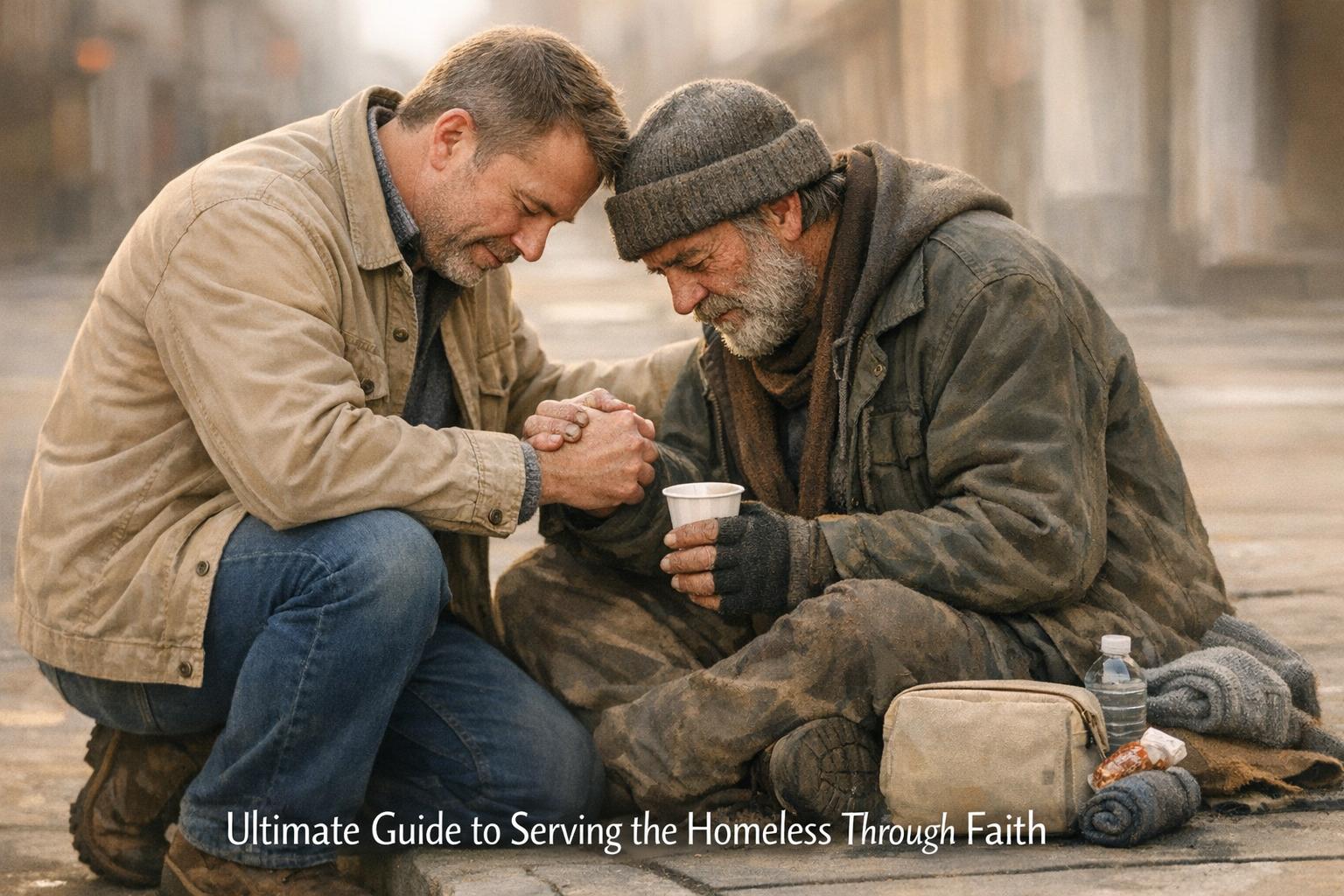
When it comes to helping the homeless, faith-based action plays a powerful role. This guide focuses on how Christian men can combine spiritual growth with practical outreach to serve those in need. Key takeaways include:
- Spiritual Preparation: Ground your efforts in prayer and scripture, focusing on compassion and emotional resilience.
- Understanding Needs: Engage with your community through observation, conversation, and local data to identify specific challenges.
- Practical Steps: Create care kits with essentials like water, snacks, and hygiene items, paired with spiritual encouragement.
- Teamwork: Work with a faith-based group to share responsibilities and build stronger connections.
- Long-Term Impact: Address root causes like addiction, mental health, and joblessness while offering spiritual mentorship.
Serving the homeless is about more than meeting physical needs – it’s about reflecting Christ’s love and building relationships that foster hope and transformation. Start small, stay prayerful, and let your actions speak your faith.
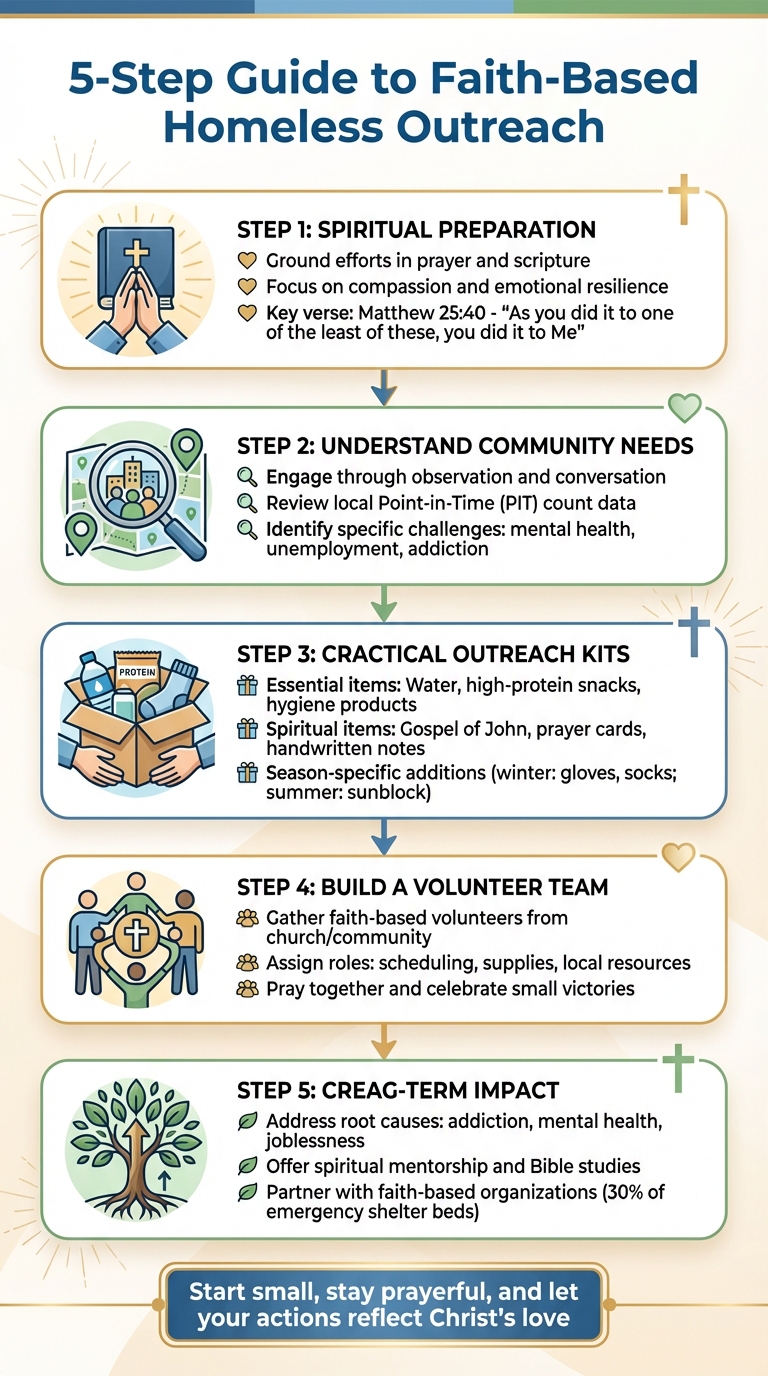
5-Step Guide to Faith-Based Homeless Outreach for Christian Men
Preparing Spiritually for Homeless Outreach
Before handing out meals or care kits, take time to prepare your heart. Homeless outreach goes beyond logistics – it’s about reflecting God’s compassion and nurturing your spiritual readiness. Without this grounding, the act of serving can feel impersonal or even counterproductive.
What the Bible Teaches About Serving Others
The Bible emphasizes that serving the homeless is akin to serving Christ Himself. Jesus, during His ministry, experienced homelessness. In Matthew 8:20, He said, "Foxes have holes and birds of the air have nests, but the Son of Man has no place to lay His head." He depended on the generosity of others, reminding us that every encounter with someone in need is an opportunity to meet Christ. As Jesus declared in Matthew 25:40, "Inasmuch as you did it to one of the least of these My brethren, you did it to Me."
The Bible consistently highlights God’s care for the vulnerable. In the Old Testament, practices like gleaning ensured that landowners left parts of their harvest for those in need, embedding compassion into the law itself. God is portrayed as a refuge for the poor and a defender of the afflicted, showing us that serving others mirrors His very character.
Building a Prayer-Focused Approach
Prayer is the cornerstone of meaningful outreach. Before heading out, ask God for wisdom to guide your actions – some situations may call for immediate help, while others might require setting healthy boundaries. Establish a consistent prayer routine, such as a 30-day guide, to shift your focus from the challenges to the people you’re serving. Another powerful practice is "Prayer Walking", where you walk through the neighborhoods you plan to serve, praying for the individuals and the specific struggles they face. This approach helps you connect with the area’s spiritual needs.
Prayer also strengthens the emotional resilience needed for this work. Pastor Matthew Spandler-Davison of Redeemer Fellowship Church advises, "Ready yourself for the emotional toll this brings." Ground yourself in scripture, like James 2:17: "Faith by itself, if it is not accompanied by action, is dead." Praying together with your church or volunteer team can uplift your spirit and help you celebrate small victories, even as you face long-term challenges. With a prayerful mindset, you can address personal doubts that might hold you back.
Overcoming Fears and Doubts
Feeling apprehensive is normal – whether it’s fear of saying the wrong thing, being taken advantage of, or not making an impact. Pastor Matthew Spandler-Davison offers this perspective:
"We must not go into ministry thinking we are people with our lives together seeking to fix broken people. Rather, we minister from a place of brokenness, knowing it is the gospel of Jesus Christ that leads to a lasting hope for restoration and recovery."
Recognizing your own need for grace allows for a deeper, more authentic connection.
If you’re unsure where to start, begin small. A smile, a kind word, or a brief conversation can break the ice and create space for the Holy Spirit to work. Carry items like Homeless Prayer Cards or pre-assembled care kits to make those first interactions feel more natural. And remember, you don’t have to do this alone. Join a faith-based volunteer group or partner with established organizations to share the emotional and physical responsibilities. For instance, a church in Kentucky started with an emergency winter shelter, which later grew into a program offering employment and discipleship opportunities.
Finally, keep Hebrews 13:2 in mind: "Do not forget to entertain strangers, for by so doing some have unwittingly entertained angels." Your role is to show up prepared, trust in God’s guidance, and let your heart and spirit lead the way in serving your community with compassion.
sbb-itb-cb63123
How to Start Serving the Homeless
Turning faith into action begins with spiritual preparation and practical steps to make a difference.
Identifying Needs in Your Community
Start by observing your community firsthand. One effective way is through prayer walking – walking through neighborhoods while praying for the people you see. This practice not only deepens your spiritual connection but also helps you spot areas where help is urgently needed.
Building personal relationships is key to understanding specific needs. Jim Reese, CEO of Atlanta Mission, emphasizes the importance of trust:
"How do you change lives? It comes from creating a relationship with them and building trust" [3].
Homelessness is often tied to complex challenges like mental health issues, unemployment, or past abuse. A simple conversation can uncover whether someone needs something as basic as warm socks, medical care, or assistance finding a job.
For a broader perspective, review local data. Many cities conduct annual Point-in-Time (PIT) counts, which provide details about the homeless population, including veterans, seniors, and families with children. Reach out to local shelters or missions to learn about service gaps, and take the initiative to engage in street outreach for those who may avoid traditional shelters [6].
Once you’ve identified needs, the next step is to prepare to meet them.
Assembling Outreach Kits
Create basic outreach kits using gallon-sized freezer bags or reusable totes [7]. Include essentials like bottled water, high-protein snacks (nuts, granola bars, or beef jerky), and hygiene items such as a toothbrush, toothpaste, deodorant, and wet wipes.
Add spiritual encouragement alongside these practical items. Include a pocket-sized Gospel of John, prayer cards, or handwritten notes sharing God’s love. These small gestures reflect care and compassion. As HavenToday.org reminds us:
"Behind every cardboard sign is a human soul who is as equally loved by God as you or me" [7].
You can make the kits more personal by writing uplifting Bible verses on water bottles or food packaging [9].
For safety, avoid including alcohol-based items like mouthwash or hand sanitizer, as they can be misused [7]. Keep scented products and soaps separate from food to avoid contamination. Also, include a resource card listing local shelters, food banks, and support services to help recipients access further assistance. Tailor your kits to the seasons – add wool socks, gloves, and hand warmers in winter, or sunblock and frozen water bottles in summer [7] [9].
While these kits address immediate needs, forming a dedicated team can amplify your efforts.
Forming a Faith-Based Volunteer Team
Gather a group of like-minded individuals from your church or community who share your passion for serving the homeless. Begin by praying together to align your vision and purpose with God’s plan [2].
Assign specific roles within the team – one person can handle scheduling, another can manage supplies, and someone else can coordinate with local resources. For example, in 2014, Starlight Ministries in Boston demonstrated the value of this approach when director Paul Daigle guided Rev. Roberto Miranda through the process of helping a homeless individual find a detox center, empowering him to navigate the system independently in the future [2].
Conduct orientation sessions to ensure everyone understands the mission and follows safety protocols [10]. Celebrate small victories together and make time for team prayer to keep spirits high and avoid burnout. Partnering with established organizations or social services can help you better identify genuine needs. Hill Cities, for instance, offers resources and a supportive community for men seeking spiritual growth and meaningful impact.
Creating Lasting Change
Once immediate needs are addressed, it’s time to focus on the deeper challenges that perpetuate homelessness. While outreach kits and volunteer efforts provide short-term relief, meaningful change happens when we tackle the root causes. Issues like addiction, mental health struggles, financial instability, and the lingering effects of incarceration require long-term, relational support.
Addressing Deeper Needs
Homelessness often arises from complex crises. Offering practical solutions like job training, addiction recovery programs, and mental health services can make a real difference. Take Redeemer Fellowship Church’s "Unlocked Apprenticeship" program, for example. This initiative combines employment opportunities, skills training, and discipleship to help individuals achieve lasting stability [1]. Pastor Spandler-Davison captures the essence of this approach:
"We minister from a place of brokenness, knowing it is the gospel of Jesus Christ that leads to a lasting hope for restoration and recovery." [1]
A balanced approach is critical. As Rachel Parker from Starlight Ministries points out, focusing solely on spiritual needs or physical support misses the mark [2]:
"Churches tend to fall on one end or another… They either hand out tracts and preach while neglecting people’s physical needs, or they feed and clothe the hungry… without addressing spiritual needs. Neither extreme is acceptable in holistic ministry." [2]
Offering Bible Studies and Spiritual Guidance
Material aid is essential, but spiritual mentorship provides the hope and direction that physical assistance alone cannot. Ministry should begin with a shared understanding of human brokenness – acknowledging that we all depend on God’s grace. Discovery Bible Studies (DBS) are an effective way to engage participants with Scripture in small, interactive groups [5].
Programs like Redeemer Fellowship Church’s "What is the Gospel?" course combine biblical teaching with life skills, creating a supportive environment for personal growth. Welcoming formerly homeless individuals into the broader church community fosters not only spiritual development but also a sense of belonging and a stable social network. This approach emphasizes non-discriminatory hospitality and compassion.
Progress may not always be linear. Some individuals might struggle or even step away temporarily. However, consistent grace and availability create a foundation for eventual transformation. By integrating spiritual mentorship with practical support, ministries can build stronger, more connected communities.
Partnering with Faith-Based Organizations
Faith-based organizations play a significant role in addressing homelessness, operating about 30% of all emergency shelter beds for families and single adults across the country [11]. Partnering with these organizations allows you to amplify your impact by tapping into their expertise, resources, and services.
Consider the example of SALT Outreach. Between August 2020 and September 2025, their mobile centers in Florida and California helped 2,041 individuals transition from homelessness [8]. Their data showed that frequent contact with services significantly increased the chances of securing permanent housing.
In Boston, Starlight Ministries has spent over 25 years equipping churches like Congregación León de Judá to handle crisis intervention independently. With just one hands-on training session, Director Paul Daigle helped Rev. Roberto Miranda navigate "Room 5", a local office for substance-abuse referrals. This enabled Miranda to connect homeless individuals to detox programs quickly and effectively [2]. Such models expand community resources and promote coordinated, compassionate responses.
Another example is Hill Cities, which provides resources and a supportive network for men seeking spiritual growth while making an impact in their communities. Through weekly gatherings and discussions, participants deepen their faith and accountability while serving the homeless.
To avoid duplicating efforts, research local shelters and advocacy groups. Support established organizations through financial contributions, volunteering, and prayer. Designating trained contacts within your ministry can also strengthen these partnerships.
As John Perkins, a civil rights activist and author, reminds us:
"The church is the body of Christ. It is to literally be the replacement of Jesus in a given community, doing what He would do, going where He would go, teaching what He would teach." [2]
Conclusion: Living Out Your Faith Through Service
Serving the homeless goes far beyond addressing physical needs – it’s about embodying Christ’s love and recognizing the shared struggles we all face. True service doesn’t come from a place of superiority; it comes from understanding our mutual need for grace. This mindset transforms charity into authentic community, where relationships hold more value than mere transactions. It builds on the spiritual preparation discussed earlier, laying the groundwork for meaningful and lasting service.
The spiritual rewards of outreach are profound. It shifts faith from passive observation to active discipleship. Through serving, you’ll cultivate Christlike compassion, grow in confidence to share the Gospel, and learn the discipline of interceding in prayer for those in need. Dr. Josh Moody, Senior Pastor of College Church, beautifully expresses this deeper call:
"A deeper response than even volunteering or activism is doing evangelism and discipleship and being one body with our brothers and sisters on the streets" [4].
True impact comes from balancing physical support with spiritual care. Holistic ministry addresses immediate needs while also planting seeds of hope through God’s reconciliation. Consider this: faith-based organizations provide nearly 60% of emergency shelter beds in the United States [12], underscoring the church’s vital role in this mission.
Now is the time to take action in your community. Whether it’s assembling outreach kits, joining a volunteer effort, or collaborating with established ministries, every step matters. Groups like Hill Cities offer resources and a network for men looking to grow in their faith while making a tangible difference through weekly gatherings and discussions. Change doesn’t happen overnight – be ready for setbacks, but remain steadfast in grace and open-hearted availability.
As this guide has shown, serving others weaves your personal faith into the fabric of community care. The homeless community needs your compassion and commitment. Through your actions, you’ll deepen your relationship with God, strengthen the unity of the church, and reveal to others what it truly means to follow Jesus.
FAQs
How can I spiritually prepare to serve the homeless?
Spiritual preparation plays a crucial role in serving the homeless with genuine humility and compassion. Begin by dedicating time to intentional prayer, asking God to guide your actions and open your heart to truly listen and understand each person’s story. Complement this with regular Scripture study, focusing on passages that emphasize service and ministry. Verses like Hebrews 1:14, Colossians 3:16, and 2 Timothy 2:15 serve as powerful reminders that serving others is not just a duty – it’s an act of worship and a reflection of God’s boundless love.
Equally important is building a strong support system. Surround yourself with other men who are also committed to spiritual growth. Faith-based groups like Hill Cities often offer weekly gatherings where you can share in prayer, study Scripture, and encourage one another. This kind of community can help you stay grounded in your faith and avoid feelings of burnout.
Lastly, approach every interaction with a Christ-centered mindset, recognizing the inherent worth and value of each individual as someone deeply loved by God. Through prayer, a foundation in Scripture, the support of a like-minded community, and a heart focused on Christ, you’ll be well-equipped to bring meaningful change and hope to those experiencing homelessness.
What are the best tips for creating care kits for the homeless?
When putting together care kits for the homeless, prioritize items that are both practical and thoughtful. Start with a sturdy, waterproof bag – something like a gallon-size zipper-lock bag works well to keep contents safe and dry. Fill the kit with essentials such as a reusable water bottle, non-perishable snacks like granola bars or trail mix, and hygiene basics like a toothbrush, toothpaste, and hand wipes. Depending on the season, consider adding sunscreen for summer or gloves for winter. To make the kit feel more personal, you could include a small gift card to a fast-food restaurant and a handwritten note offering words of encouragement.
Be mindful of what not to include. Avoid fragranced products that could affect food items or anything alcohol-based. Tailor the kits to the current season, and store them in a cool, dry spot until you’re ready to hand them out. When distributing a kit, approach with warmth – make eye contact, offer a kind word, and engage in a brief, respectful conversation if the person is open to it. These small, thoughtful gestures can make a big difference in someone’s day.
How can faith-based organizations meet both the physical and spiritual needs of the homeless?
Faith-based organizations have a unique opportunity to address both the physical and spiritual needs of the homeless by blending practical support with compassionate care for their overall well-being. The first step is understanding the specific needs of the local community and organizing efforts to provide essentials like meals, clothing, hygiene supplies, and safe shelter. Volunteers can play a key role in this effort, taking on tasks such as preparing meals, assisting with guest intake, or maintaining facilities. Every interaction should prioritize respect and dignity, making those in need feel valued.
In addition to meeting physical needs, spiritual outreach can be seamlessly incorporated. This might include offering prayer, Bible studies, worship services, or opportunities for mentorship. By seeing each individual as someone navigating a personal crisis, these organizations can focus on providing consistent love, encouragement, and hope rooted in the teachings of Christ. Programs like those from Hill Cities exemplify this approach, helping men grow spiritually while empowering them to give back to their communities. This creates a well-rounded approach that nourishes both the body and the soul.