

Fear and anxiety can feel overwhelming, but the Bible provides powerful verses to help you find peace and strength through prayer. Here are ten key scriptures that guide you in overcoming fear:
- Psalm 27:1: A reminder that God is your light, salvation, and stronghold – there’s no need to fear.
- Isaiah 41:10: God promises His presence, strength, and help, urging you not to be afraid or discouraged.
- Philippians 4:6-7: Replace worry with prayer and thanksgiving to experience God’s peace.
- Joshua 1:9: A call to courage, trusting that God is with you wherever you go.
- Psalm 56:3: A simple yet profound verse about turning fear into trust in God.
- Psalm 34:4: Seek God, and He will deliver you from all your fears.
- Deuteronomy 31:6: God will never leave or forsake you, offering strength and courage.
- 2 Timothy 1:7: God gives you power, love, and a sound mind – not fear.
- Psalm 55:22: Cast your burdens on God, and He will sustain you.
- Psalm 46:1: God is your refuge and strength, always present in trouble.
Each verse encourages trust in God’s promises and provides actionable prayers to confront fear. Speaking these scriptures aloud can help replace anxious thoughts with peace and confidence. Remember, fear is natural, but you don’t have to face it alone – God’s presence is constant, and His Word is a powerful tool in overcoming life’s challenges.
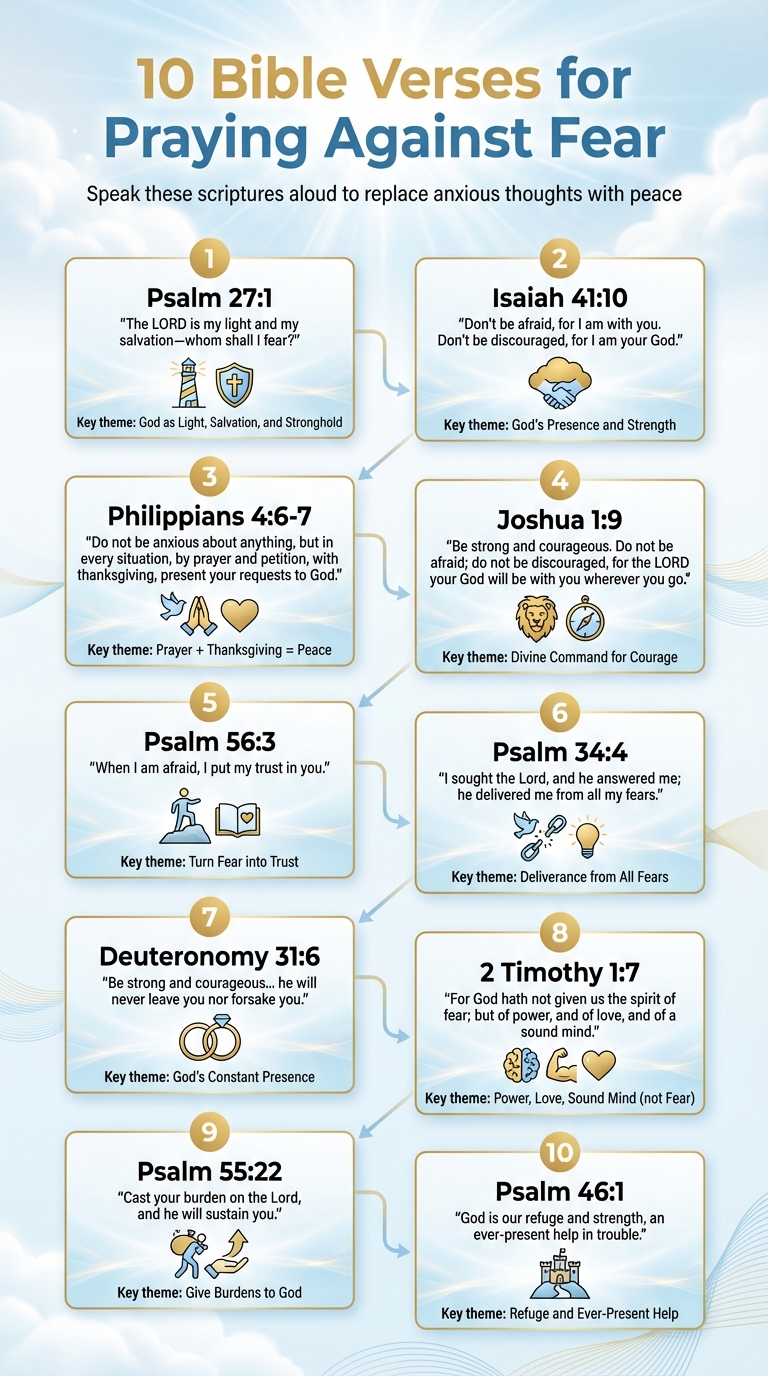
10 Bible Verses for Praying Against Fear – Quick Reference Guide
1. Psalm 27:1
"The LORD is my light and my salvation – whom shall I fear? The LORD is the stronghold of my life – of whom shall I be afraid?" – Psalm 27:1 (NIV) [1]
This verse beautifully portrays God in three profound roles: light, salvation, and stronghold. As light, He dispels confusion and guides the way. As salvation, He rescues from danger and offers deliverance. And as a stronghold, He provides a secure refuge in times of trouble [1].
The rhetorical questions, "whom shall I fear?" and "of whom shall I be afraid?" emphasize the unmatched power of God. They remind us that no earthly threat can compare to His strength and protection [2].
To incorporate this verse into prayer, personalize it as a declaration of faith. Speak it aloud: "The Lord is my light and my salvation; I will not fear. The Lord is the stronghold of my life; I will not be afraid." Repeat these words until they replace the anxious "what ifs" with a sense of peace and confidence. This practice not only reinforces trust in God but also aligns with the broader message of relying on His strength throughout life’s challenges.
"We might still feel afraid, but we can believe that God is with us. We may not be in control, but we can trust the One who is." – Debbie McDaniel, Writer and Pastor’s Wife
In daily life, this verse serves as a powerful reminder of God’s protection during trials. Whether facing financial struggles, health concerns, or family difficulties, view God as a fortress – a place of safety and strength. By focusing on His power rather than personal limitations, we can shift our perspective and find renewed hope [1]. Hill Cities encourages this mindset in their gatherings, promoting spiritual growth through trust and personal declarations of faith.
sbb-itb-cb63123
2. Isaiah 41:10
Isaiah 41:10 builds on Psalm 27:1’s message of God as our refuge, offering a more detailed assurance of His active presence in our lives.
"Don’t be afraid, for I am with you. Don’t be discouraged, for I am your God. I will strengthen you and help you. I will hold you up with my victorious right hand." – Isaiah 41:10 (NLT) [3]
This verse provides five key promises: God’s presence, His covenant relationship, strength, help, and protection. Each of these promises is designed to strengthen faith and provide comfort. The command "don’t be discouraged" directly addresses moments of panic, encouraging trust in His unwavering faithfulness. By declaring, "I am your God", the verse underscores a personal and protective relationship, reminding us that His grace is a shield during times of trial.
To make this verse part of your prayers, try personalizing it. For instance, you might pray: "Lord, I will not fear because You are with me. I will not be discouraged because You are my God. Please strengthen and guide me." When anxiety sneaks in, you can also turn to The Message translation for a fresh perspective:
"Don’t panic. I’m with you. There’s no need to fear for I’m your God. I’ll give you strength. I’ll help you. I’ll hold you steady, keep a firm grip on you." – Isaiah 41:10 (MSG) [4]
Whether you use the NLT or MSG version, this verse is a powerful reminder to shift your focus from personal struggles to God’s unwavering strength.
3. Philippians 4:6-7
Philippians 4:6-7 doesn’t just tell us to let go of anxiety – it gives us a clear, actionable way to confront fear head-on.
"Do not be anxious about anything, but in every situation, by prayer and petition, with thanksgiving, present your requests to God. And the peace of God, which transcends all understanding, will guard your hearts and your minds in Christ Jesus." – Philippians 4:6-7 (NIV)
The term "anxious" here points to the kind of worry that scatters your thoughts and keeps you stuck in a loop of fear [6]. Prayer becomes the tool to refocus and recenters those scattered thoughts. But it’s not just any prayer – it needs to be specific. Daniel Niranjan, Founder of Divine Disclosures, breaks it down perfectly:
"Philippians 4:6–7 is a Spirit-filled pattern: worry → prayer with thanksgiving → peace of God → guarded heart and mind" [6].
The key is to pair your prayers with thanksgiving. Why? Because remembering how God has been faithful in the past strengthens your trust in Him now. Every specific worry you bring to Him becomes an opportunity to recall His past provision – a quiet act of defiance against despair [6]. This practice doesn’t just ease anxiety; it transforms it into trust.
Then comes God’s peace – His shalom – a peace so profound that it goes beyond what our minds can grasp. This peace doesn’t just calm; it protects. The Greek word phroureō, translated as "guard", is a military term that paints a picture of steadfast defense [6].
"God’s own peace sets a garrison around the very places anxiety attacks you – the heart that feels and the mind that spins" [6].
After praying, take a moment. Let God’s peace settle over you like a shield. But don’t stop there – cooperate with that peace. Resist the urge to doom-scroll through bad news or dwell on worst-case scenarios. Instead, shift your focus to things that are true, uplifting, and worthy of praise [5][6].
The next verse continues to show how Scripture equips you to face fear with confidence. Stay tuned.
4. Joshua 1:9
Joshua 1:9 is more than just a comforting verse; it’s a call to action packed with purpose and reassurance.
"Have I not commanded you? Be strong and courageous. Do not be afraid; do not be discouraged, for the LORD your God will be with you wherever you go." – Joshua 1:9 (NIV)
The words “Have I not commanded you?” aren’t a mere suggestion – they’re a directive from God Himself, underscoring His supreme authority (John Gill [7]). This isn’t about passive encouragement; it’s a divine mandate to step forward with confidence.
The verse highlights two major hurdles: fear, which symbolizes external pressures, and discouragement, the internal struggle of losing hope. Together, they represent the challenges we often face both outside and within ourselves. But the promise in Joshua 1:9 is clear – God’s presence equips us to face both head-on.
When you pray, bring these challenges to the forefront. Whether it’s an intimidating work conversation, an upcoming medical appointment, or a tough financial choice, remind yourself of God’s unwavering presence. As noted in the Targum of Jonathan, this assurance isn’t just theoretical; it’s meant to be actively lived out in moments of uncertainty.
For further encouragement and prayer resources, consider connecting with Hill Cities, a community committed to supporting men in their spiritual growth (https://hillcities.org).
5. Psalm 56:3
Psalm 56:3 openly acknowledges fear while guiding us to place our trust in God.
"When I am afraid, I put my trust in you." – Psalm 56:3 (ESV)[9]
Notice the phrasing: "When I am afraid" – not if but when. This subtle choice of words reminds us that fear is a universal part of being human, even for those with strong faith. David penned this Psalm during a time of genuine danger, making his words deeply personal and relatable.
What makes this verse so impactful is its simplicity and immediacy. It doesn’t suggest ignoring or suppressing fear but instead encourages a direct response: turning fear into trust. As John Gill noted, trusting God is the most effective way to counter fear[10].
When you pray, try naming your fear out loud, even briefly, and then follow it with a declaration of trust in God. This practice won’t magically erase fear, but it can shift your perspective, transforming worry into a moment to lean on God’s unwavering love and faithfulness.
This emphasis on trust sets the stage for even deeper insights in the verses that follow.
6. Psalm 34:4
Psalm 34:4 beautifully illustrates how God remains steadfast during our most trying times.
"I sought the Lord, and he answered me; he delivered me from all my fears." – Psalm 34:4 [11]
The context behind this verse adds incredible depth to its meaning. David penned these words while hiding in Gath, a city where he was surrounded by enemies and forced to feign madness to survive. Even in such a dire situation, David turned to God – and God responded. As John Gill observed, "The Lord heard and answered even his unspoken groans." [12] This wasn’t a public display of faith but an intimate, heartfelt plea for help.
The phrase "all my fears" carries significant weight. In the original Hebrew, it reflects deliverance from "the whole, all, any and every" fear, emphasizing that no fear is too trivial or overwhelming for God to handle. Importantly, this verse doesn’t promise the immediate removal of external threats. Instead, it highlights the inner peace and divine reassurance that God provides, even when danger looms.
When life’s pressures make it hard to pray aloud, take inspiration from David. Seek God silently in your heart, knowing that He hears even your quietest cries. Let your anxiety become a moment to lean on Him, transforming challenges into opportunities to experience His faithfulness.
For men looking to grow spiritually, Hill Cities (https://hillcities.org) offers a supportive community for connection and fellowship.
7. Deuteronomy 31:6
Deuteronomy 31:6 encourages strength and courage, offering the comforting reminder of God’s constant presence:
"Be strong and courageous. Do not be afraid or terrified because of them, for the Lord your God goes with you; he will never leave you nor forsake you." – Deuteronomy 31:6
These words, spoken by Moses to the Israelites as they prepared to enter the Promised Land, highlight a profound truth: strength doesn’t come from human effort alone but from trusting in God’s unwavering presence. The challenges ahead were intimidating, but this command reassured them that they weren’t facing those battles alone. The Septuagint translation emphasizes this reliance on divine strength over personal bravery.
This promise – that God will never abandon His people – is echoed later in Hebrews 13:5. When fears creep in with "what if" scenarios, this verse serves as a powerful reminder: God is already ahead, preparing the way.
In moments of fear or uncertainty, try speaking this verse aloud as a declaration of faith. Reflect on past experiences where you felt God’s protection, and let those memories renew your courage.
The imagery tied to this verse is deeply comforting. The ESV Study Bible describes God as carrying His people "as a man carries his son" [8]. It paints a picture of tender, fatherly care – a reminder that God’s guidance is not distant or impersonal. When you feel overwhelmed or alone, hold onto this image in prayer. Picture yourself being carried through challenges, and let that assurance replace panic with peace. This loving image can transform how you face difficulties, reminding you that you’re never walking through them alone.
8. 2 Timothy 1:7
This verse offers a powerful reminder as we continue exploring ways to confront fear. In 2 Timothy 1:7, we see a sharp contrast between fear and the gifts that God provides:
"For God hath not given us the spirit of fear; but of power, and of love, and of a sound mind." – 2 Timothy 1:7 (KJV)
Paul penned these words to Timothy, urging him not to let fear or hesitation prevent him from fulfilling his calling. The message is clear: fear does not come from God. Biblical scholar John Gill describes this fearful spirit as a "pusillanimous, cowardly spirit" that is "not from God, and such a fear brings a snare." [13][14] Recognizing that fear is not a gift from God is the first step in breaking free from its grip.
Instead of fear, God equips us with three transformative gifts: power to face challenges head-on, love that shifts our focus outward, and a sound mind that anchors us in clear and balanced thinking. These gifts are meant to guide not only our thoughts but also our prayers as we seek to overcome fear.
When you pray, you can actively embrace these gifts. Ask for the power to tackle obstacles, the love to extend yourself to others, and the sound judgment to make wise decisions. The Message translation beautifully captures this idea:
"God doesn’t want us to be shy with his gifts, but bold and loving and sensible." [14]
This verse challenges us to awaken these gifts through prayer. Don’t let fear suppress them. Instead, let your prayers fan the flame, transforming these gifts from a spark into a powerful force that dispels darkness.
9. Psalm 55:22
When fear feels overwhelming, Psalm 55:22 offers a profound reminder: give your burdens to the Lord. David penned this psalm during a time of intense distress and betrayal, making his words all the more powerful:
"Cast your burden on the Lord, and he will sustain you; he will never permit the righteous to be moved." – Psalm 55:22 (ESV)
This verse doesn’t promise an immediate removal of your struggles. Instead, it assures that God will sustain you through them. The Message translation puts it this way: "Pile your troubles on GOD’s shoulders – he’ll carry your load, he’ll help you out. He’ll never let good people topple into ruin." It’s a comforting reminder of God’s unwavering presence and strength, even in life’s most challenging moments. Through prayer, we don’t escape reality but find the resilience to face it.
Rob Hill, a pastor and author, emphasizes the importance of turning to God in difficult times: "Taking our anguish, the anguish of our soul, to God in prayer is the first and the absolutely necessary step when we feel that anguish in our hearts." When the instinct to run away from a tough situation arises, use that moment to connect with God instead.
In these prayers, practice letting go. Name the specific fears or "what-ifs" weighing you down. As theologian John Gill noted, burdens can refer to "the burden of afflictions, which is sometimes very heavy… their only relief under it is to look to Christ." A simple prayer like, "Lord, I am casting this specific care on You because You promised to sustain me", can be a powerful act of trust.
For those seeking spiritual support, Hill Cities offers a community for men dedicated to growing in their faith. Whether through group prayer or personal reflection, embracing the message of Psalm 55:22 can be a meaningful step toward finding peace and strength in the face of fear.
10. Psalm 46:1
Psalm 46:1 offers a powerful reminder of God’s constant presence and protection:
"God is our refuge and strength, an ever-present help in trouble." – Psalm 46:1 (NIV)
This verse highlights two key aspects of God’s character. First, He is your refuge – a safe place where you can find shelter from life’s storms. Second, He is your strength – providing the power you need to face challenges head-on. Whether you’re navigating financial strain, leadership responsibilities, or family pressures, you can rely on God’s unwavering support.
The phrase "ever-present help" carries deep meaning. It reassures us that God is not a distant bystander but actively involved in every moment of difficulty. He is with you right now, ready to intervene and guide you through your struggles. As Frank Powell, Lead Writer and Editor at Bayside Church, explains:
"God is the only answer to anxiety, I believe. Sure, you can turn to other outlets – thousands of them – but they won’t give you peace. Maybe false security or temporary relief, but nothing that lasts."
When you pray, try naming your specific challenge – for example, "Lord, you are my refuge in this crisis." Doing so can make God’s protection feel more immediate and personal. For men seeking to deepen their spiritual journey and overcome fear, Hill Cities (https://hillcities.org) provides a welcoming community. Through weekly gatherings and meaningful discussions, you’ll find practical ways to apply verses like Psalm 46:1 to everyday challenges, all while connecting with others who are committed to growing in faith.
Conclusion
These ten Bible verses offer a steady foundation when life feels uncertain. Speaking God’s Word aloud replaces anxious thoughts with affirmations of trust and confidence. Each verse serves as a reminder that, even in the face of the unknown, you can rely on the unchanging nature and promises of God.
Praying scripture helps transform fear into faith. As Debbie McDaniel, writer and pastor’s wife, wisely says, "We may not be in control, but we can trust the One who is. We may not know the future, but we can know the God who does." The Bible never condemns feelings of fear – it encourages you to take steps forward, grounded in trust. Let these verses shape your prayers and guide you through life’s challenges.
Through prayer, you actively confront fear, exchanging anxiety for a peace that guards your heart and mind. When worry starts to take hold, shift your focus from the problem to the One who holds your future. Personalize these verses as you pray: "Lord, I will not fear because You are with me."
Faith grows stronger in community. Hill Cities (https://hillcities.org) provides a space for men to connect, pray, and live out these truths together. With free weekly gatherings and meaningful conversations, you’ll find encouragement and support to deepen your faith and face life’s uncertainties alongside others on the same journey.
FAQs
How can I use Bible verses to pray against fear in my daily life?
To incorporate Bible verses into your daily prayers to combat fear, start by selecting passages that resonate with your current challenges. Verses like Isaiah 41:10 and Philippians 4:6-7 emphasize God’s strength and peace, making them powerful tools for moments of anxiety. Use these scriptures in your prayers by reading them aloud, meditating on their meaning, and asking God to help you lean on His promises.
Consider jotting these verses down in a journal, placing them on sticky notes around your home, or saving them on your phone for easy access. Seeing and repeating them often can help shift your perspective from fear to faith, reminding you of God’s constant presence and power. With time, this habit can reshape how you face anxiety, offering comfort and a renewed sense of trust.
What can I do if I still feel anxious after praying these Bible verses?
If you’re still feeling anxious after praying, it’s important to remember that finding peace doesn’t always happen instantly. It’s a journey. Keep reflecting on God’s Word, praying regularly, and holding onto His promises. Over time, this steady practice can help deepen your sense of calm and build your faith.
Being part of a faith-based community, like Hill Cities, can also be a source of comfort and encouragement. Sharing your experiences with others who share your beliefs can make a world of difference. You might also find it helpful to seek guidance from a trusted spiritual mentor or counselor. Sometimes, pairing prayer with practical support can be a powerful way to address ongoing anxiety.
Above all, give yourself grace. The Bible encourages us to bring every worry to God, trusting that His peace will protect our hearts and minds. Stay committed to your faith, and trust that healing will come in God’s perfect timing.
Can these Bible verses help with fears related to finances or health?
When life feels overwhelming – whether it’s concerns about money, health, or other struggles – these Bible verses can offer a sense of peace and encouragement. They serve as reminders of God’s unwavering promises to care for, guide, and sustain us through tough moments. Reflecting on these scriptures can help you feel His presence more deeply and strengthen your trust in His plan for your journey.